
The maritime security environment in the Red Sea as of January 2026 represents a complex mixture of asymmetric warfare, regional power realignments, and structural shifts in global logistics. Following more than two years of sustained disruption started by the Houthi movement (Ansar Allah) the theater has transitioned from a localized conflict into a primary driver of global supply chain re-engineering. [1] For US commercial shipping, the start of 2026 is characterized by a precarious stability: while a 100-day hiatus in kinetic attacks has fostered tentative test transits by major carriers, the underlying threat to US-flagged and US-linked vessels remains substantial, governed by sophisticated weaponry and shifting geopolitical alliances. [2]
Figure 1: Map highlighting critical maritime routes including the Suez Canal, Bab el-Mandeb, and the Strait of Hormuz, critical for global trade and energy transport.
The Evolution of the Asymmetric Threat Landscape
The Houthi movement has fundamentally altered the paradigm of maritime security by showing that a non-state actor can exert strategic influence over global trade routes through low-cost, high-impact technology. Since the escalation of attacks in late-2023, the southern Red Sea, the Bab el-Mandeb Strait, and the Gulf of Aden have become contested areas where traditional naval deterrence has seen significant limitations.
Figure 2: Map showing incidents off the coast of Yemen, showing maritime security concerns in the Bab al-Mandeb Strait and surrounding areas.
Kinetic Capabilities and Tactical Sophistication
As of January 2026, the Houthis have executed over 120 attacks on commercial vessels. These operations use a diverse arsenal including anti-ship ballistic missiles (ASBMs), cruise missiles, one-way attack unmanned aerial vehicles (UAVs) and unmanned surface vehicles (USVs).[4]
Figure 3: Anti-ship missile impacts erupt alongside the commercial tanker, Magic Seas. Source: NBCNews
A critical development in mid-2025 was the Houthi-announced maritime blockage of Israel, which expanded the targeting criteria to include any vessel within a company fleet if any other vessel in that fleet had called at an Israeli port.
The tactical evolution culminated in July 2025 with the successful sinking of the bulk carriers Magic Seas and Eternity C. These sinkings were particularly significant as they occurred in the absence of rapid-response naval presence, emboldening the Houthis to demonstrate their capability for textbook escalation. [5] The weapons used in these attacks included electro-optically guided Asef ASBMs and anti-ship variants of the Qasim missile, showing a level of precision previously associated only with nation-state militaries.
Figure 4: Overview of Houthi anti-ship ballistic missiles, their origins, ranges, and guidance systems.Figure 5: Recovered Houthi one-way attack UAV components; low-cost, modular systems used to conduct precision strikes on commercial shipping in the Red Sea.Figure 6: Illustrative overview of Houthi “Blowfish” USV variants.
Current Security Status: The 100-Day Hiatus
The beginning of 2026 has been marked by a notable pause in kinetic activity. The last confirmed Houthi attack ona merchant vessel occurred on 29 September 2025, involving the Minervagracht. This hiatus is mostly attributed to an ongoing, albeit fragile, ceasefire agreement and a monitoring period by Houthi forces. [6] However, the Joint Maritime Information Centre (MIC) and other maritime authorities warn that this pause is highly contingent on the stability of regional peace pacts; a collapse in the Gaza ceasefire would very likely trigger and immediate return to Houthi attacks on US, UK, and Israeli-affiliated interests.
Figure 7: Long-term trends in Suez Canal traffic show steady growth in vessel count and tonnage over decades, highlighting how recent Red Sea disruptions represent a sharp deviation from a historically resilient global trade artery.
Maritime Security Incident Summary: Jan 2026 Baseline
Details
Source
Total Recorded Houthi Attacks (Nov 2023 – Jan 2026)
120+
[2]
Current Sueze Canal Transit Reduction
60% below 2023 levels
[3]
Last Kinetic Strike Date
29 September 2025
[3]
Vessels Sunk Since Conflict Inception
4 (Rubymar, Tutor, Magic Seas, Eternity C)
[5]
Primary Threat Level for US/UK/Israeli Interests
Moderate
[6]
Electronic Warfare and Hybrid Threats
Beyond kinetic strikes, the Red Sea corridor is plagued by significant electronic interference. In early-January 2026, maritime authorities reported “critical” levels of Global Navigation Satellite System (GNSS) and AIS interference in the vicinity of Port Sudan and “severe” levels near JeFddah Port. [10] This interference suggests ongoing kinetic activity or electronic countermeasures by state and non-state actors, complicating navigation for commercial vessels and reducing the effectiveness of collision-avoidance systems.
The security vacuum in the region has also facilitated a resurgence of Somali piracy. On 1 January 2026, a Chinese-flagged fishing vessel was hijacked off the coat of Somalia, indicating the Pirate Action Groups (PAGs) are actively monitoring the region’s naval focus on the Houthis to resume ransom-based operations. This collision of piracy and state-level conflict increases the collateral risk for any US-flagged vessel transiting the Gulf of Aden. [11]
Impact on US Commercial Shipping Operations
The Red Sea crisis has necessitated a fundamental shift in the operational strategies of US-based shipping firms. The transition from the Suez Canal route to the Cape of Good Hope has moved from an emergency measure to a new normal, with profound implications for costs, lead times, and risk management. [12]
Figure 8: Cape of Good Hope rerouting adds roughly 3,500 nautical miles, higher costs, and longer transit times compared to the Suez Canal route.
Normalization Attempts and the Maersk Denver Case
The beginning of January 2026 saw a high-profile attempt to normalize US-flagged transits. The Maersk Denver, a US-flagged container vessel, successfully transited the Bab el-Mandeb Strait on 11-12 January. [14] This marked Maersk’s second successful transit since December 2025, and the carrier has indicated a stepwise approach to gradually resuming Red Sea navigation, provided security thresholds continue to be met.
However, the maritime industry remains divided. While Maersk and CMA CGM have tested the route, the Premier Alliance has announced that its network for the first half of 2026 will continue to utilize the Cape of Good Hope route. [15] The reluctance of the broader market to return is reflected in the 60% deficit in Sueze Canal traffic compared to early 2023.
Economic and Supply Chain Macro-Dynamics
For US shippers, the Cape of Good Hope detour adds approximately 3,500 nautical miles to voyages, increasing transit times by 8 to 17 days. This extended journey has substantial financial consequences:
Operational costs: Rerouting can add between $2 million and 4$ million USD per voyage in fuel and crew expenses. [17]
Freight rates: Freight rates remain 25% to 35% above pre-crisis benchmarks as of Jan. 2026.
Insurance: War risk insurance premiums for Red Sea transits have surged to between $150,000 and $500,000 USD per voyage, making the route economically prohibitive for many carriers.
Economic Variable
Impact on US East Coast Imports (2026)
Source
Additional Transit Time
10-17 days
[2]
Capacity Absorption
6%-9% of global fleet
[12]
Average Additional Cost per TEU
$200 -$400
[17]
Inventory Carrying Cost Increase
15%-25% due to transit delays
[17]
Figure 9: Snapshot of the Red Sea crisis impact, showing sharp freight-rate spikes, extended transit times, and widespread carrier diversions as shipping avoids the Red Sea corridor.
A critical risk identified in Q1 2026 is the double wave of arrivals. As some carriers return to the Sueze route while others remain on the Cape route, vessels may arrive at US East Coast and European ports simultaneously. This phenomenon is expected to cause significant port congestion and trigger inland bottlenecks for trucking and rail for several months.
US Port and Regional Considerations
Specific US logistics nodes are feeling the strain of these reroutes. For example, construction delays at Houston’s Bayport terminal have forced the MECL service to shift to Barbours Cut for the first eight weeks of 2026, complicating capacity management during the anticipated pre-Chinese New Year cargo surge. [21] Furthermore, US import volumes from China fell by over 20% in early 2025 as shippers sought more reliable West Coast routings, though East Coast volumes are expected to see a seasonal uptick in early 2026.
Institutional and Regional Security Realignments
The international community’s response to the Red Sea crisis has entered a new phase in 2026, characterized by a transition in US-led naval missions and the emergence of regional security blocs.
Operation Prosperity Guardian (OPG) and DESRON 50
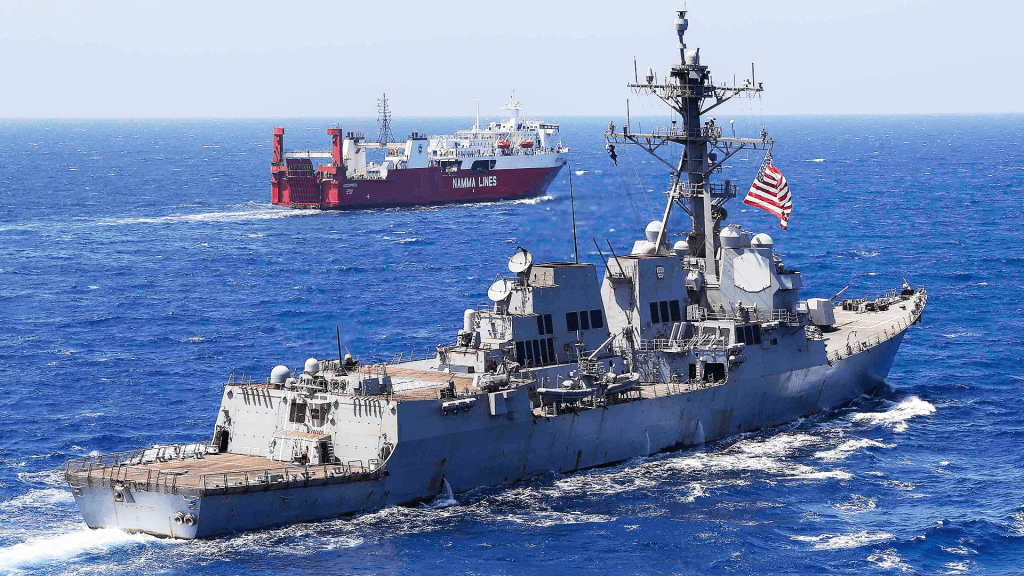
Operation Prosperity Guardian, the multinational maritime security initiative launched in December 2023, remains active but has undergone organizational shifts. In February 2025, responsibility for the mission was transferred from Combined Task Force 153 to Destroyer Squadron (DESRON) 50, a surface warfare task force under U.S. Naval Forces Central Command. [23] DESRON 50 continues to lead the highway patrol mission in the Red Sea, providing persistent defensive presence and coordinating with industry partners through the JMIC.
Figure 10: US Navy destroyer escorts a commercial vessel in the Red Sea, showing the reliance on naval protection to sustain maritime trade through contested waters. Source: TWZ.
Despit OPG’s tactical brilliance (including the first combat use of Standard Missile 3 for ballistic missile defense) critics argue it has been a strategic failure in its primary goal of restoring merchant confidence and pre-conflict shipping volumes. [25] The disparity between the high cost of naval interceptors and the low cost of Houthi drones continues to challenge the sustainability of the current defensive posture.
The “Red Sea Axis”: A Saudi-Turkey Alignment
A major geopolitical development in January 2026 is the proposed formation of a joint naval task force led by Saudi Arabia and Turkey. [28] This “Red Sea Axis” represents a movement toward regional strategic autonomy, looking to fill the perceived vacuum in Western-led security frameworks.
Ankara Meeting (7 January 2026): High-level naval delegations from Turkey and Saudi Arabia met to establish mechanisms for joint exercises, planning integration, and operational compatibility.
Strategic Logic: The task force looks to incorporate littoral states like Egypt, Djibouti, Somalia, and Sudan to confront revisionist actors and protect important maritime commerce.
Technological Enabler: Turkey’s “Blue Homeland” doctrine and its export of Bayraktar Akinci UCAVs provide the technical backbone for this coalition, allowing for 24-hour continuous surveillance over the Bab el-Mandeb independent of US assets.
Figure 11: Map of the Red Sea littoral highlighting key ports, chokepoints, and adjacent states central to global maritime trade and regional security dynamics. Source: NationsOnline
EUNAVFOR Aspides
The European Union has extended its maritime security operation, EUNAVFOR Aspides, until 28 February 2026. [29] Unlike US-led missions, Aspides maintains a strictly defensive mandate, focused on escorting vessels and intercepting threats without conducting strikes on Houthi land-based assets. While this role is crucial, the mission remains under-resources, with only three to four naval units typically to cover the vast high-risk area.
Defensive Technologies and Onboard Protocols for 2026
As of 2026, the maritime industry has adopted a range of advanced defensive measures and technological countermeasures to mitigate the risks of asymmetric attack.
Counter-UAS (C-UAS) and Directed Energy Weapons (DEW)
The US Navy is accelerating the deployment of non-kinetic defense systems. Project METEOR, a high-powered microwave (HPM) prototype, is scheduled for shipboard testing in 2026. [30] This system is built to defeat cheap UAVs and anti-ship ballistic missiles by disabling their electronic components with microwave energy, providing a low-cost-per-shot alternative to million-dollar missiles.
Figure 12: US Army’s THOR (Tactical High Power Operational Responder) system using high-power microwave energy to disable multiple UAS simultaneously.
Internationally, the Greek-developed Centaur C-UAS system has proven highly effective during its deployment on Hellenic Navy Frigates. [31] The Centaur system uses passive receivers to detect drones at long distances and targeted jamming to neutralize them without using kinetic munitions. These developments are critical for commercial operators, as traditional land-based C-UAS systems often fail in the harsh, high-motion maritime environment. [32]
Official Maritime Security Guidance (MARAD)
The US Maritime Administration (MARAD) maintains active advisories for all US-flagged vessels operating in high-risk waters. Advisory 2025-012, effective 26 March 2026, outlines the following critical protocols:
AIS suppression: US-flagged vessels are strongly advised to turn off their AIS transponders when transiting the southern Red Sea and Bab el-Mandeb, as the Houthis use AIS data for accurate targeting.
Electronic signature reduction: Crews are advised to secure Wi-Fi routers and minimize all electronic signals that could be used for localization.
Armed security details: While the use of private maritime security companies is at the master’s discretion, they have proven effective in deterring boardings and small-boat approaches when combined with evasive maneuvering.
Houthi deceptive communications: Vessels should ignore VHF hails or emails from “Yemeni authorities” instructing them to divert course or activate AIS, as these are common tactics to facilitate targeting.
MARAD Active Advisory (Jan 2026)
Regional Focus
Effective Until
2025-012
Red Sea, Bab el-Mandeb, Gulf of Aden, Somali Basin
26 March 2026
2025-013
Foreign Adversarial Cyber/Technical Influence
4 April 2026
2025-014
Global Maritime Security Resources
4 April 2026
2025-015
Gulf of Guinea
13 June 2026
Regulatory Changes Effective 1 January 2026
The beginning of 2026 introduced several mandatory international regulations that intersect with the Red Sea security situation, adding new compliance layers for US operators.
Mandatory Container Loss Reporting
Under new amendments to the IMO’s SOLAS and MARPOL conventions, all ships need to immediately report any container lost overboard. [35] This regulation is particularly pertinent given the Red Sea crisis, as the 191% increase in transits around the Cape of Good Hope has exposed vessels to more extreme weather, leading to a significant rise in container losses; 35% of the 2024 global total occurred near South Africa.
STCW Amendments and Seafarer Safety
Amendments to the STCW Code also entered into force on 1 January 2026, mandating basic training for seafarers on preventing and responding to bullying and harassment. While focused on workplace culture, these measure are part of a larger industry push to support seafarer mental health and safety during the prolonged stress of transiting high-risk conflict zones.
Energy Security and Global Macro-Economic Implications
The Red Sea disruption has reshaped the global energy trade, with US energy exports playing a stabilizing role in the face of Middle Eastern volatility.
Oil and LNG Flux
The Red Sea is a critical corridor for 8.5 million barrels per day of crude and refined products. [40] The rerouting of tankers around the Cape of Good Hope has increased freight rates for oil by almost 500% since the conflict began. [41] US Gulf Coast complex refiners have emerged as winners in this environment, as European markets have increasingly pulled in US distillates to replace Middle Eastern supplies delayed by the longer Cape route.
The Hormuz Interdependency
A major strategic concern for 2026 is the link between the Red Sea and the Strait of Hormuz. Authorities warn that any major conflict expansion involving Iran could lead to the closure of Hormuz, which handles 20 million barrels of oil per day; nearly 20% of global supply. If both the Red Sea and Hormuz were compromised, the global market would face an unprecedented energy crisis, leaving the US and North America as the primary reliable suppliers of oil and LNG to the world.
Figure 13: Global LNG trade routes and major liquefaction plants as of 2026, highlighting key exporters and importers.
Strategic Outlook and Recommendations
As 2026 progresses, the maritime security environment in the Red Sea remains in a state of unstable equilibrium. The hiatus in attacks has allowed for a cautious resumption of transits by carriers like Maersk, but the structural threats posed by Houthi asymmetric capabilities remains unresolves.
Forecast for 2026-2027
Analysts expect that the Red Sea will stay a contested space for the near future. Even if a permanent regional ceasefire is reaches, the Houthi precedent has shown that small forces can successfully disrupt global trade, a lesson likely to be emulated by other non-state actors in chokepoints like the Strait of Malacca or the Strait of Hormuz.
Operational Forecast 206
Strategic Implication
Source
Phased Return to Suez
Q2/Q3 2026 expected return for larger carrier groups
12
Freight Rate Normalization
Rates expected to drop as rerouted capacity is released
12
Persistent Cyber Threats
Increased GNSS/AIS spoofing targeting US vessels
4
Regional Alliance Growth
Expansion of Saudi-Turkey naval coordination
28
Recommendations for US Commercial Operators
For US shippers and carriers, the 2026 security environment dictates a posture of cautious resilience.
Risk-based routing: Carriers are advised to maintain a phased approach to Red Sea transits, utilizing test voyages and individual risk assessments for each vessel rather than a wholesale return.
Adherence to MARAD guidelines: Strict compliance with AIS and electronic signal suppression is important for reducing the targeting footprint of US-flagged vessels.
Supply-chain diversification: Shippers must continue to buffer lead times and diversify their supplier base to mitigate the impacts of potential chokepoint disruptions elsewhere in the global network.
In summary, the Red Sea in 2026 is no longer a taken-for-granted transit lane but rather a high-risk operational theater. The safety of US commercial shipping now relies on a sophisticated blend of naval protection, regional diplomacy, and advanced onboard security protocols. While the 100-day pause in attacks offers a glimmer of hope for normalization, the strategic volatility of the region ensures that the Cape route will remain a vital, if expensive, component of the global maritime map for the years to come.
Venezuela has increasingly become a narco-state where high-level officials enable drug trafficking to sustain their power. US authorities accuse Nicolas Maduro and his inner circle (dubbed “Cartel of the Suns“) of colluding with criminals to ship cocaine abroad. While not a traditional cartel hierarchy, this term best reflects how the regime allows criminal networks to operate in exchange for loyalty and funds. The result of this is a steady flow of cocaine through Venezuelan territory from Colombian producers, using Venezuela’s porous borders and ports as the transit points. These illicit revenues help Caracas offset economic collapse under sanctions, propping up Maduro’s government when legitimate oil income fell. In turn, Venezuela’s instability and lawlessness (fueled by drug money, corruption, and mass migration) have regional spillover effects, straining neighboring countries and providing openings for foreign powers to step in as patrons and exploiters.
Cuba’s Lifeline and Intelligence Footprint
Cuba has arguably the most intimate stake in Venezuela’s survival. Since the era of Hugo Chavez, a Caracas-Havana axis has existed where Venezuela ships subsidized oil to Cuba, literally keeping Cuban lights on. Without the Venezuelan oil lifeline, Cuba’s economy would be unsustainable, a fact that cements Havana’s interest in shoring up Maduro. In exchange, Cuba provides extensive political and security assistance. Over the past two decades, thousands of Cuban personnel, including doctors, teachers, but also security and intelligence advisors, have been posted in Venezuela. They advise and embed within Venezuelan military units and intelligence services, imparting Cuba’s decades of know-how in surveillance, counterintelligence, and political repression. This Cuban contingent is widely seen as a pillar of Maduro’s regime stability, helping prevent military coups and monitoring potential dissent. In essence, Havana leverages Venezuela’s turmoil (and its own advisors on the ground) to maintain an allied government and extend Cuba’s influence in South America. The partnership is deeply symbolic: Venezuela supplies Cuba with energy and funds, and Cuba’s security apparatus works to keep Caracas in friendly hands, frustrating US attempts to isolate the Maduro regime.
Russia’s Military and Strategic Leverage
Russia has has also cultivated Venezuela as a strategic foothold in the Western Hemisphere. Since Hugo Chavez reached out to Moscow in 2000, Russia became a vital source of arms, oil investments, and diplomatic backing for Venezuela. Billions in weapon sales, from aircraft to air defense systems, and joint projects in oil fields ensued, not always yielding profit for Moscow but serving a geopolitical purpose. In return, the Kremlin gained a significant presence in South America, fulfilling Putin’s ambition to challenge the US in its own backyard. By propping up Caracas, Russia forces Washington to divert attention and resources, effectively acting as a spoiler to US interests. Even amid Russia’s war in Ukraine, Moscow has maintained military ties with Venezuela. In May 2025, the two signed a Strategic Partnership Treaty to expand cooperation in energy, mining, defense technology, and intelligence sharing. Russian oil firms also quietly supply Venezuela with crucial diluents to keep its heavy crude flowing. Furthermore, Russia and Venezuela regularly engage in military exchanges and joint exercises, where Venezuela even hosted segments of Russia’s International Army Games in 2022). In past crises, the Kremlin showed willingness to deploy assets like sending strategic bombers and air defense units to Venezuela during moments of heightened US pressure. All of this highlights how Moscow leverages Venezuela’s anti-US stance and need for security guarantees to deepen its footprint. From intelligence operatives on Venezuelan soil to warship visits, Russia uses Venezuela as a forward base of influence in LATAM, complicating US strategic calculus. Notably, both countries vocally oppose US “unilateral sanctions” and invoke principles of non-intervention, aligning themselves at the UN and other forums. In short, Venezuela’s turmoil and isolation have been a golden opportunity for Russia to project its power westward, cementing an alliance that counters US presence in the region.
China’s Economic Stakes in Venezuela
China’s approach centers on economic and technological entrenchment in Venezuela. Over the last 15 years, Beijing has loaned Venezuela over $50 billion in exchange for oil. Even as Venezuela’s oil industry deteriorated, China remained its major buyer, responsible for nearly 3/4 of Venezuela’s oil exports, often through intermediaries to evade sanctions. Much of this oil repays Chinese loans, and steep discounts give China’s refiners a bargain supply. Outside buying oil, Chinese state giants hold enormous stakes in Venezuela’s oil reserves. As the chart below shows, Sinopec and CNPC together claim rights to over 4.4 billion barrels of Venezuelan oil.
Figure 1: CN state firms Sinopec and CNPC hold the largest oil entitlements in VE, surpassing RU, US, and other foreign firms through joint ventures with PDVSA. Source: Morgan Stanley Research, Wood Mackenzie
These investments grant Beijing long-term influence over venezuela’s most prized asset. China has also expanded into infrastructure and high-tech realms: Huawei built Venezuela’s national telecom backbone, ZTE designed the controversial “Fatherland Card” ID and social control system, and China’s CEIEC helped set up surveillance networks. Such technology transfers embed Chinese systems deep into Venezuela’s governance and security apparatus. In effect, Venezuela has become an outpost for China’s Digital Silk Road and resource acquisition strategy. Beijing leverages Venezuela’s financial desperation to secure favorable deals in oil, minerals, and telecom, all while portraying itself as Venezuela’s dependable partner amid US sanctions. China’s presence yields geopolitical dividends too; it gains political goodwill across LATAM for standing by Venezuela, and it challenges US influence by offering an alternative development model. However, China treads carefully; it has at times slowed new loans or investments, wary of Venezuela’s instability and inability to repay. Still, with a recent agreement on promoting bilateral investments (signed May 2024) and high-profile state visits, Beijing signaled its commitment to deepening ties with Caracas for mutual strategic benefit.
Venezuela as a Platform for Extra-Regional Influence
For Cuba, Russia, and China, an embattle Venezuela serves as a gateway to project power in LATAM. Under Chavez and Maduro, Caracas spearheaded an alliance of leftist governments (the ALBA bloc) that resisted US policies. Venezuela once bankrolled regional clients with oil subsidies (i.e. PetroCaribe program), buying influence in the Caribbean and Central America. Today, even with resources diminished, Venezuela provides a friendly territory for US rivals to operate. Intelligence reports indicate that Russian and Iranian military personnel have used Venezuelan bases to cooperate on drone programs and other strategic projects. Meanwhile, Cuba uses Venezuela as a forward post for its intelligence network in South America, extending Havana’s reach beyond the island. By hosting foreign military advisors, allowing port calls, or brokering diplomatic support, Venezuela amplifies the global influence of its patrons. Caracas often votes with Beijing and Moscow at the UN, and in turn receives diplomatic cover; for example, joint opposition to US “unilateral sanctions” has been a refrain of Venezuela, China, and Russia alike. The Venezuelan regime also harbors Colombian guerrilla groups and traffickers, whose activities destabilize neighboring Colombia and beyond. Importantly, Venezuela’s mere alignment with great-power competitors transforms it into a symbolic beachhead, demonstrating that US dominance in the Western Hemisphere can be contested. This emboldens other populist or authoritarian leaders in LATAM who seek multi-polar alternatives. In summary, Venezuela’s drug-fueled instability and anti-US stance make it a convenient platform for Cuba’s ideological agenda, Russia’s military forays, and China’s economic inroads, extending these countries’ influence throughout South America under the cover of “South-South” cooperation.
US-Mexico Counter-Narcotics Efforts
Facing an unprecedented fentanyl overdose epidemic at home, the US has refocused on counter-narcotics cooperation with Mexico as a linchpin of its regional strategy. over 100k American die annually from drug overdoses, primarily fentanyl, putting intense pressure on Washington to act. Most illicit fentanyl is manufactured by Mexican cartels using Chinese-sourced precursor chemicals, then smuggled across the US-Mexico border. Yet until recently, Mexico was reluctant to confront the cartels head-on, even claiming Mexico does not produce fentanyl. Cooperative security programs like the Merida Initiative stagnated as Mexico scaled back US law enforcement presence and hollowed out joint anti-drug efforts. This approach gave transnational cartels free rein, worrying US officials. In late-2023, however, signs of a shift had emerged. Through intense diplomacy (and some hardball tactics like hinting at trade tariffs), the Biden administration got Mexico to acknowledge the crisis. Bilateral agreements were reached in late-2023. Around the same time, China agreed to re-engage in narcotics cooperation, promising to police chemical exports more rigorously after high-level talks.
Concrete actions followed these understandings. US pressure coincided with Mexico’s military capturing major cartel figures, most notably Ovidio Guzman (son of “El Chapo”), who was extradited to the US in September 2023 on fentanyl trafficking charges. The US Drug Enforcement Administration also helped Mexican forces target clandestine fentanyl labs, while joint operations at the border (like Operation Plaza Spike) ramped up inspections of vehicles for hidden drugs. By late-2024, under mounting US pressure, Mexico reportedly deployed thousands of troops to its northern border and stepped up seizures of fentanyl pills and precursor chemicals. This growing collaboration is reshaping narcotrafficking routes as land routes into Texas and Arizona toughen, cartels have begun exploring alternate corridors via sea and Central America. There is also evidence that traffickers are adapting by using new chemicals and dodging Chinese export curbs, a reminder that the narco-network is flexible and will seek the path of least resistance. Still, Washington’s message is that Mexico’s partnership is critical. Improved US-Mexico cooperation also serves as a counterweigh to extra-hemispheric actors: it shows that North America can tackle its own security problems, leaving less excuse for outside powers to meddle under the pretext of addressing lawlessness.
Implications for US National Security and Regional Stability
These developments carry far-reaching implications. US national security is directly challenged when hostile powers gain a foothold in the Americas under the guise of aiding a beleaguered Venezuela. The growing presence of Russian military advisors, Chinese tech infrastructure, and Cuban intelligence operatives in Venezuela undermines the traditional US sphere of influence and could threaten American assets or allies in the region. For example, Russia’s support to Venezuela is explicitly aimed at countering US influence in LATAM. Such encroachment harkens back to Cold War era concerns and has led US strategists to reassert the Monroe Doctrine logic of keeping external adversaries out of the hemisphere. Indeed, Venezuela’s alignment with Cuba, China, and Russia is cited in Washington as an unacceptable beachhead for “the United States’ main opponents” in its backyard. The illicit drug trade exacerbates this strategic contest. The Venezuelan regime’s role in narcotrafficking not only finances its own repression; it also exports instability northward (in the form of drugs and refugees) and tarnishes US credibility when the problem grows. American policymakers argue that failing to check Venezuela’s narco-network and its foreign sponsors would embolden other anti-US regimes and signal decline of US leadership.
On the other hand, a robust US counter-narcotics push, especially in partnership with Mexico, could alter the balance. Success in curbing fentanyl flows and cartel power would deprive Venezuela (and by extension Cuba/Russia) of one modus operandi for influence (the chaos and corruption spread by drug money). It would also bolster US standing as a security provider in LATAM, perhaps reassuring countries that Washington, not Beijing or Moscow, can best address regional crises. Already, the extradition of a top fentanyl trafficker and the slight dip in US overdose deaths in 2024 have been lauded as proof that coordinated action yields results. However, there are risks. If the US approach veers into unilateral military action (as some hawks urge, citing narco-terrorism), it could spark backlash akin to past interventions, playing into the hands of Cuba, China, and Russia, who would eagerly condemn US “imperialism” and rally regional opinion against Washington. Striking a balance is key: the US looks to strengthen alliances (like with Mexico and Colombia) to choke off drug routes, while diplomatically isolating Venezuela’s regime and its enablers. The coming years will test whether this strategy can stabilize LATAM’s drug economy without inflaming geopolitical tensions. One thing is clear: Venezuela’s crisis has become a linchpin issue at the crossroads of organized crime and great power rivalry. The outcome will significantly shape US influence and the security architecture of the Western Hemisphere for years to come
Disclaimer: The following is an academic exercise and the information below was obtained through open-source, unclassified platforms and research.
Excuse the plethora of formatting issues; this was brought over from my original Microsoft Word document. I would suggest reading from the original PDF linked here for visuals and clearer formatting.
Chinese military modernization likely reshapes regional deterrence dynamics through 2031. The PLA strengthens its ability to sense, target, and strike regional forces by integrating long-range precision fires, expanded space-based ISR, advanced electronic warfare capabilities, and sustained naval pressure. These developments likely reduce allied warning time, increase China’s coercive leverage, and elevate the risk of rapid escalation during crises.
Key Findings:
China likely enhances its precision-strike capability through integrated ISR networks and long-range missile forces. Expanded deployment of DF-26, DF-17, and conventional strike brigades strengthens China’s ability to target US and allied bases across the First and Second Island Chains.
The PLA likely improves its situational awareness through rapid growth in space-based ISR. New Yaogan electro-optical, synthetic aperture radar (SAR), and SIGINT satellites give Chinese commanders persistent regional surveillance that supports time-sensitive targeting and reduces allied decision time.
China’s electronic warfare modernization likely degrades allied sensing and complicates early warning efforts. Expanding PLA EW brigades and multispectral deception capabilities increase the likelihood that China can disrupt radar, obscure force movements, and challenge ISR platforms during crisis onset.
PLAN expansion likely intensifies coercive pressure near Taiwan’s outlying islands. Routine encirclement drills and heightened presence around Kinmen, Matsu, and Pratas allow Beijing to normalize elevated military activity and shape the battlespace before potential conflict.
US and allied denial strategies likely preserve credible deterrence through 2031. Dispersed basing, hardened C2, expanded ACE (agile Combat Employment) and EABO (Expeditionary Advanced Base Operations) operations, and improved trilateral intelligence sharing complicate Chinese strike planning and reduce the probability of decisive PLA success in the opening phase of conflict.
PLA limitations in joint integration and sustained fires likely constrain operational effectiveness. Magazine depth, battle-damage assessment challenges, and uneven command integration reduce China’s ability to maintain rapid strike tempo during extended conflict periods.
This document compiles a term-long body of analytic work that examines China’s military modernization and its implications for regional deterrence through 2031. X directed the analyst to produce one overarching long-form assessment and several short-form analytic reports (SFARs) that address distinct aspects of the People’s Liberation Army’s (PLA) evolving operational capability. The final product integrates these assessments to provide a consolidated view of how PLA advancements in strike systems, space-based ISR, electronic warfare, and naval operations influence crisis stability and allied warning time in the Indo-Pacific.
The analyst approached this task by applying structured analytic methods that included trend analysis, evidence weighting, competitive hypothesis evaluation, and cross-domain capability assessment. The overarching long-form analytic report (LFAR) synthesizes the primary judgments developed across the term, supported by the more narrowly focused SFAR reports. Each SFAR assesses a specific modernization vector that contributes to China’s broader military posture. Together, these products show how PLA modernization affects regional dynamics and shapes Beijing’s coercive leverage.
This document includes the Overview LFAR, one previously submitted LFAR, and four SFARs. It reflects only publicly available information and employs estimative language consistent with Intelligence Community analytic standards. The analytic judgments represent the analyst’s best assessment of likely trajectories and operational implications based on currently available evidence.
Chinese Military Modernization Likely To Reshape Indo-Pacific Deterrence Through 2031
Executive Summary:
Chinese military modernization across strike, space-based ISR, naval, and electronic warfare systems likely reshapes Indo-Pacific deterrence through 2031. The PLA accelerates long-range precision-strike integration, fields hypersonic weapons, and strengthens satellite-enabled targeting that compresses allied warning timelines. The PLAN increases coercive pressure around Taiwan’s outlying islands through sustained presence and encirclement drills. US and allied denial strategies, deeper space and missile-warning cooperation, and persistent PLA weaknesses in integration and sustainment likely preserve credible deterrence. Escalation risk likely peaks between 2026 and 2029 as China tests maturing capabilities.
Key Findings:
Drivers
The PLA expands long-range precision fires and fuses them with space-based and airborne ISR, which likely enables coordinated theater-wide strikes within 72 hours of conflict initiation.
China fields DF-17 and advances DF-27 hypersonic weapons, which likely compress allied decision timelines and expand Chinese strike reach to Japan, Taiwan, Guam, and carrier groups.
PLA commanders strengthen electronic warfare and counter-ISR capabilities through long-range jammers, passive detection arrays, and multispectral deception systems, which are likely to degrade allied situational awareness by 2028.
The PLAN intensifies coercive pressure around Taiwan’s outlying islands through sustained fleet growth, routine encirclement drills, and blended Coast Guard and PLAN operations.
Constraints
US, Japanese, and Taiwanese commanders expand denial strategies such as ACE, EABO, mobility, dispersion, and deception, along with efforts to harden and reconstitute ISR and space-based warning systems, which likely complicate PLA strike planning and preserve deterrence.
PLA units struggle with limited magazine depth, uneven joint integration, and inconsistent battle damage assessment capability, including under contested space and electromagnetic conditions, which limits sustained high-tempo operations.
US-Japan-Taiwan coordination strengthens shared situational awareness, including space and missile warning, and crisis management, and likely offsets escalation pressures during China’s 2026–2029 capability-testing period.
Discussion:
PLA Strike and ISR Integration Reshapes Regional Deterrence
PLA commanders continue to integrate long-range precision fires with a maturing ISR enterprise. Rocket Force units field larger inventories of DF-26 and DF-21 variants and pair them with high-fidelity targeting networks that KJ-500A aircraft, over-the-horizon radars, and Yaogan and Gaofen satellites support. These networks shorten the sensor-to-shooter cycle and likely enable rapid, theater-wide strike options during the opening phase of a Taiwan contingency.
Chinese planners now pursue a system that collects, identifies, and strikes targets within a compressed decision window. This approach moves China beyond earlier Anti-Access/Area Denial (A2/AD) concepts. Instead of limiting US intervention through distance alone, the PLA now looks to impose operational paralysis by striking key nodes before allied forces reposition or disperse.
Space-Based ISR Growth Likely Enhances Targeting But Increases Reliance On Vulnerable Assets
Recent developments in PLA space-based ISR suggest a deliberate effort to build layered constellations that provide persistent, all-weather coverage of the Western Pacific. China fields and upgrades electro-optical, synthetic aperture radar, maritime surveillance, and electronic intelligence satellites that together improve wide-area search, cueing, and refined target location for long-range missile systems. As revisit rates improve and data from multiple sensors are fused, Chinese commanders likely gain more continuous tracks on US and partner naval forces, forward airbases, and logistics nodes. This space-based ISR network enhances the effectiveness of PLA strike systems but also increases Beijing’s dependence on vulnerable on-orbit assets in a crisis against a capable counterspace adversary.
China’s leadership views this integrated strike and ISR system as the foundation for “intelligentized warfare,” which emphasizes cognitive pressure, accelerated decision cycles, and multisource fusion. PLA writings often highlight the need to seize initiative through speed, information dominance, and coordinated fires rather than rely solely on static defense.
Hypersonic Weapons Compress Decision Time and Expand PLA Strike Options
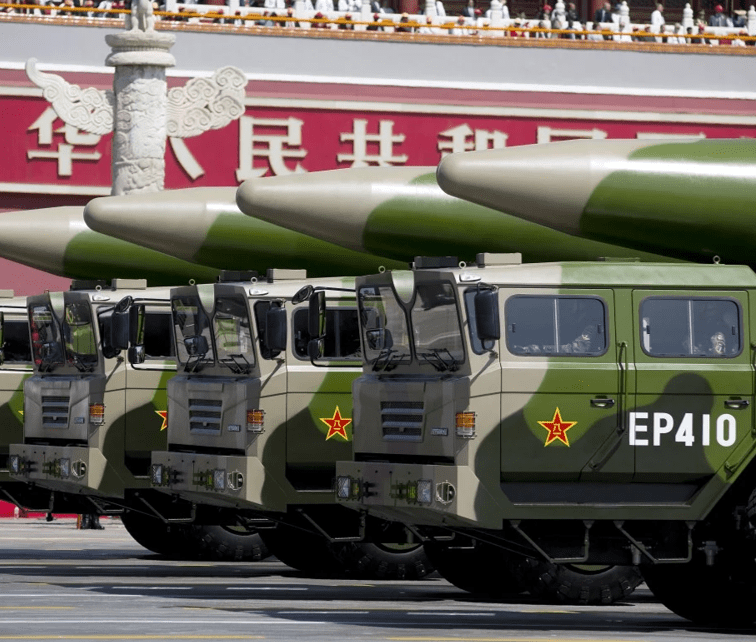
PLA Rocket Force units field DF-17 hypersonic glide vehicles and advance DF-27 development to extend strike reach deep into the Pacific. DF-17 likely gives China maneuverable, survivable options against regional fixed targets, while DF-27 likely threatens Guam and carrier strike groups.
Hypersonic weapons reshape crisis dynamics because they impose extreme time pressure on decision-makers. Their maneuverability complicates prediction, their speed reduces warning, and their flight profiles challenge interception. Chinese officials publicly describe hypersonics as stabilizing tools, but Chinese force structure, exercises, and doctrinal commentary increasingly position them as coercive instruments that exploit gaps in regional missile defenses.
These systems allow Chinese commanders to execute rapid precision campaigns while generating significant cognitive stress on adversaries. Japan, Taiwan, and the US must therefore allocate resources toward dispersal, mobility, and hardened infrastructure to offset Chinese hypersonic advantages.
Electronic Warfare and Counter-ISR Modernization Threatens Allied Early Warning
PLA officers invest aggressively in electronic warfare and counter-ISR capabilities that disrupt sensing, delay targeting, and undermine confidence in allied situational awareness. PLA brigades employ long-range jammers that target airborne ISR platforms, passive detection systems that track aircraft without emitting signatures, and multispectral deception platforms that overload or confuse sensors. PLA researchers also pursue cognitive EW concepts that allow real-time adaptation of jamming strategies.
Eastern Theater Command training increasingly links EW brigades with air defense and missile units. These exercises demonstrate Chinese intent to blind or confuse allied ISR networks during the initial phase of conflict. Chinese commanders want to create uncertainty, force allied hesitation and reduce the ability to detect PLA preparations.
If Chinese EW units disrupt early-warning systems, allied commanders face delayed detection of missile dispersal, amphibious staging, or decoy deployments. This disruption likely increases escalation risk due to reduced clarity producing pressure to act early or reposition quickly without complete information.
PLAN Growth Increases Pressure On Taiwan’s Outlying Islands
The PLA Navy expands surface and amphibious forces and sustains routine presence near Taiwan’s outlying islands. Chinese destroyers, frigates, and amphibious ships conduct coordinated maneuvers around Pratas, Kinmen, and Matsu. Chinese commanders normalize encirclement patterns that convey political pressure, gather ISR, and chart Taiwanese response behavior.
PLAN and Coast Guard units also cooperate to blend coercive signaling with a veneer of maritime law enforcement. Chinese policymakers frame these operations as domestic jurisdictional enforcement while they simultaneously erode Taiwan’s operational freedom. This dual-purpose approach strengthens Beijing’s coercive leverage and complicates allied assessments of Chinese intent.
Sustained PLAN pressure strains Taiwan’s maritime forces, increases operational fatigue, and challenges indicator-and-warning frameworks that are needed to distinguish routine Chinese presence from pre-invasion preparations.
PLA Leaders Pursue Cross-Domain Integrations As The Core Of Coercive Power
Chinese planners seek to combine precision fires, ISR fusion, EW disruption, hypersonic reach, and naval pressure into a coherent system that shapes the battlespace before conflict. This cumulative approach produces effects that exceed the value of each capability individually.
PLA leaders pursue the ability to:
Identify, classify, and track targets across domains
Strike with speed and precision
Blind or confuse adversary sensors
Pressure Taiwan through persistent naval presence
Exploit ambiguity around hypersonic reach and maneuverability
This integrated system looks to weaken allied decision cycles and exploit any hesitation created by degraded situational awareness. Cross-domain integration therefore represents the most consequential transformation within Chinese military modernization.
Allied Denial And Resilience Strategies Likely Preserve Deterrence Through 2031
US, Japanese, and Taiwanese commanders adapt to PLA modernization with resilient denial strategies. ACE disperses aircraft across multiple austere sites, and EABO places maritime and missile units in difficult-to-target locations. Taiwan increases survivability by expanding mobility, deception, and distributed fires. Japan strengthens early-warning networks and deepens US cooperation.
These measures complicate PLA targeting cycles and reduce China’s ability to achieve decisive outcomes in the opening phase of conflict. Chinese commanders still struggle with magazine depth, joint integration, and battle damage assessment, which limits PLA endurance in high-tempo operations.
These realities likely sustain credible deterrence despite rapid Chinese modernization.
Escalation Risk Likely Peaks Between 2026 and 2029
Beijing plans to test and validate new capabilities during this period. PLA units will likely conduct high-tempo joint strike drills, expand maritime exclusion zones, intensify cyber and information operations, and run complex EW exercises that probe allied ISR resilience.
These activities increase friction because they blend training, coercion, and intelligence collection. Without reliable crisis-communication mechanisms between Washington and Beijing, even minor incidents, like an aircraft intercept or an ambiguous missile flight, could escalate quickly.
The convergence of maturing capabilities and aggressive testing cycles likely makes 2026-2029 the most dangerous window for miscalculation.
Analytic Confidence
I assess confidence in this judgement as medium-high. I anchored the assessment in structured analytic reasoning and several corroborating open sources, including DoD annual reports, research institute findings, and regional defense assessments. PLA operational proficiency, command integration, and readiness timelines remain uncertain, but observable modernization patterns strongly support the judgments presented.
PLA Strike And ISR Modernization Likely Shapes Taiwan Strait Deterrence Through 2031
Executive Summary:
By 2028, the People’s Liberation Army (PLA) will likely achieve a 72-hour strike and ISR overmatch in the Taiwan Strait. Allied denial and resilience measures will very likely preserve credible deterrence through 2031. Crisis stability from 2026 to 2029 will remain fragile as Beijing tests coercive thresholds through exercises and information operations. Modernization will likely shift deterrence toward denial and resilience models. Emerging indicators such as DF-26 expansion and J-20B and J-35 deployments will likely confirm PLA readiness for integrated precision campaigns.
Key Findings
Drivers
The rapid expansion of long-range precision strike and ISR capabilities will likely allow the PLA to conduct coordinated, theater-wide attacks within 72 hours of conflict initiation. Over the past decade, China has significantly increased the number of DF-26 and DF-21 variants, fielded the YJ-21 hypersonic missile, and improved its command-and-control networks linking satellite, radar, and airborne sensors. These systems now provide the PLA Rocket Force with greater reach and target discrimination across the First Island Chain, reducing response times from hours to minutes.[i]
Beijing’s pursuit of its 2027 military modernization goal is accelerating efforts to achieve joint integration and real-time targeting. The Central Military Commission has directed the services to meet operational benchmarks that align with “intelligentized warfare,” integrating space-based ISR, cyber, and electronic warfare into combined-arms operations. This timeline places pressure on the PLA to demonstrate readiness for a Taiwan contingency before the end of the decade, explaining the pace and scope of its procurement and exercise activity.[ii]
Expanding satellite constellations and persistent ISR coverage will likely give China short-term coercive leverage during the early phase of any Taiwan contingency. The launch of new Yaogan and Gaofen satellites, paired with KJ-500A early warning aircraft and over-the-horizon radar, enables the PLA to maintain continuous track of surface and airborne targets. These capabilities will improve battle damage assessment and shorten the sensor-to-shooter cycle, increasing Beijing confidence in its ability to neutralize key military and logistics nodes during the opening hours of a conflict.[iii]
Constraints
Allied denial measures such as dispersed basing, deception, and mobile missile systems will very likely preserve credible deterrence through at least 2031. The U.S. Pacific Deterrence Initiative, Japan’s defense buildup plan, and Taiwan’s asymmetric modernization collectively emphasize survivability over retaliation. Distributed operations under Agile Combat Employment (ACE) and Expeditionary Advanced Base Operations (EABO) doctrines allow forces to operate from austere or temporary locations, complicating PLA targeting cycles and ensuring continued operational capacity after initial strikes.[iv]
Limitations in PLA joint command integration, magazine depth, and battle damage assessment will likely prevent sustained operational dominance. While China’s modernization has improved hardware and ISR, the ability to fuse these assets into synchronized joint operations remains uneven. The Rocket Force’s limited munitions stockpiles, combined with insufficient training time for joint targeting and post-strike assessment, would constrain the duration of effective large-scale operations against Taiwan and allied forces.[v]
Strengthened coordination and crisis management among the United States, Japan, and Taiwan may mitigate escalation risks during Beijing’s 2026–2029 testing phase. Trilateral planning, shared situational awareness, and expanded communication channels increase the likelihood that gray-zone or coercive PLA activities will be managed before triggering direct conflict. While friction is inevitable, consistent transparency and signaling across alliances will reduce the probability of unintended escalation during China’s period of capability testing and deterrence signaling.[vi]
Discussion
PLA Long-Range Strike Integration
The PLA is entering a decisive modernization phase aimed at closing operational gaps with the U.S. and regional partners. Central to this effort is their integration of long-range precision fires with an expanded ISR architecture. Systems like the DF-26 ballistic missile, YJ-21 hypersonic anti-ship missile, and H-6N air-launched strike platform form the backbone of China’s regional strike capability. Supported by KJ-500A early warning aircraft and the growing Yaogan and Gaofen satellite constellations, these systems are designed to create continuous situational awareness and enable rapid targeting decisions. By 2028, the PLA will likely be capable of executing coordinated, theater-wide strikes within 72 hours of conflict initiation, creating a short-term deterrence shock window that could paralyze Taiwan’s command-and-control (C2) before external intervention.
Comment: The PLA’s emphasis on pairing ISR with precision strike assets demonstrates its move toward “intelligentized” joint warfare, allowing for more rapid decision loops and reduced warning time for adversaries. This integration poses a significant challenge for Taiwan’s early warning network, which heavily relies on U.S. and Japanese shared ISR coverage.
Allied Adaptation And Denial Posture
Despite these advancements, the U.S., Japan, and Taiwan are adapting their deterrence posture to emphasize denial and resilience rather than punishment. The Agile Combat Employment (ACE)[vii] and Expeditionary Advanced Base Operations (EABO)[viii] concepts reflect this shift, enabling forces to disperse, relocate, and reconstitute quickly under contested conditions.[ix] Taiwan’s emphasis on mobile missile systems, coastal defense, and rapid runway repair further complicates PLA targeting cycles and limits the effectiveness of a first strike.[x] These adaptations make it highly likely that deterrence will remain credible through 2031, even as the PLA approaches full modernization.
Comment: ACE and EABO show that U.S. and allied strategy is evolving to counter PLA long-range precision fires by reducing predictability and improving survivability. This approach will reduce the likelihood of a successful first strike but will require sustained logistical readiness and allied interoperability to remain credible.
Crisis Stability And Escalation Risk (2026-2029)
Crisis stability remains fragile from 2026 to 2029 as Beijing tests coercive thresholds through large-scale joint strike exercises, maritime exclusion zones, and integrated cyber and information campaigns. These actions normalize aggressive behavior and help PLA units collect intelligence on allied response patterns. [xi]
Comment: The lack of reliable crisis communication between Beijing and Washington increases the risk of accidental escalation during periods of military exercise or cyber operations. Intelligence on PLA intent will be crucial, as deception and misinformation continue to be key components of Chinese operational planning.
Transition Toward Resilience-Based Deterrence
Deterrence in the Indo-Pacific is shifting toward denial and resilience as PLA strike precision and ISR reach expand. The decisive factor increasingly becomes how quickly each side can restore operational capacity after initial strikes. By 2031, the side capable of reconstituting combat power within hours rather than days likely holds the advantage in a Taiwan contingency.[xii]
Comment: PLA modernization is reshaping deterrence dynamics in the Taiwan Strait, yet conflict is not inevitable. The determining factor will be the resilience and adaptability of allied forces. Sustained investments in deception, rapid repair, and agile logistics is likely to deter aggression more effectively than increased offensive capacity, demonstrating that endurance is now central to credible deterrence.
Analytic Confidence
I assess confidence in this judgment as moderate. I used the Analysis of Competing Hypotheses (ACH) method to evaluate how PLA modernization affects regional stability. Source reliability ranges from high to very high across DoD reports, CSIS analysis, and Taiwan’s defense publications. Uncertainty remains around PLA command integration, exercise objectives, and readiness levels, though observed modernization patterns strongly support this assessment.
PLA Navy Expansion Highly Likely To Escalate Pressure On Taiwan’s Outlying Islands
Executive Summary:
It is highly likely the PLA Navy (PLAN) will escalate gray-zone coercion against Taiwan’s outlying islands over the next 12–18 months because rapid naval modernization, amphibious fleet growth, and blockade-style exercises are expanding Beijing’s capabilities. Despite U.S. and regional pushback, Beijing is unlikely to scale back, as sustained shipbuilding and increased patrols since mid-2024 show intent to steadily erode Taiwan’s operational space.
Discussion:
The PLAN continues to add surface combatants, submarines, and amphibious vessels at a pace unmatched regionally. Recent U.S. Department of Defense (DoD) reporting on Chinese military modernization claims China commissioned more than a dozen major combatants in 2024, and construction at Jiangnan and Huludao shipyards indicates further acceleration through 2026. These new platforms expand Beijing’s ability to maintain constant patrols and escalate presence around Taiwan’s outlying islands.
Since early 2025, PLAN vessels have routinely maneuvered within proximity to Pratas and Kinmen. Researchers reported on 22 September 2025 that several PLAN ships conducted coordinated movements around these islands, assessing this activity as part of gray-zone coercion operations.[xiii] Recent analysis suggests the Strait Thunder 2025A exercise signaled an intent to normalize higher-tempo coercion in the Strait, reinforcing expectations of sustained pressure on Taiwan.[xiv]
Contrasting research from Chinese maritime sources frames coast guard patrols near Taiwan’s outlying islands as routine inspections under domestic law, portraying them as stabilizing measures. These operations often coincide with PLAN patrols and exercises, providing a law-enforcement veneer to military pressure in contested waters.[xv]
Analytic Confidence:
The analytic confidence for this assessment is high. The analyst used ACH to weigh competing hypotheses as the structured method of analysis. Sources are recent, assessed at medium to high reliability, and provide both corroboration and contrasting perspectives. Both the task complexity and the analyst’s expertise are moderate. The time available was sufficient and the analyst worked alone with no collaboration.
Hypersonic Missile Expansion Highly Likely To Erode Regional Deterrence In The Next 12-24 Months
Executive Summary:
It is highly likely that China’s DF-17 and DF-27 hypersonic glide vehicle (HGV) systems will weaken regional deterrence within 12–24 months. Open-source reporting indicates continued PLA Rocket Force modernization that stresses existing missile defenses and compresses decision timelines. Beijing presents hypersonics as a defensive and stabilizing offset to missile defenses, but current indicators point to growing coercive leverage across the Western Pacific.
Discussion:
China’s hypersonic missile development is a key component of military modernization. The U.S. Department of Defense (DoD) reported in December 2024 that the PLA Rocket Force continues to field the DF-17 and pursue the longer-range DF-27, with ranges sufficient to strike Guam. External assessments of the DoD report highlight the DF-27’s potential as both a conventional and anti-ship platform, expanding China’s capacity to hold forward bases and carrier groups at risk.[xvi]
Chinese state documents and media describe hypersonics as defensive and stabilizing offsets intended to deter intervention, counter missile defenses, and protect sovereignty.[xvii] Allied and independent assessments judge the same capabilities as coercive, citing reduced warning time, stressed layered defenses, and increased crisis instability even if technical uncertainties persist.
Open-source analysis notes unresolved issues in guidance, thermal protection, and reliable re-entry control, and cautions that public demonstrations may overstate maturity.[xviii] China’s opacity and limited visibility into hypersonic testing sustain uncertainty around DF-27 payloads, production scale, and unit-level proficiency. At the same time, recent studies project continued Chinese investment in hypersonics to offset U.S. missile defenses, extend strike options deeper into the Pacific, and reinforce regional deterrence posture.[xix]
Analytic Confidence:
The analytic confidence for this assessment is medium. The analyst applied ACH to weigh competing perspectives, considering both U.S. assessments and Chinese official framing. The source base is recent and generally reliable, with contrasting viewpoints on maturity and strategic effects. Uncertainties remain on DF-27 performance parameters, production scale, and unit proficiency. The task complexity and analyst’s expertise are moderate. The analyst worked alone with no collaboration and time available was adequate.
PLA Integrated EW And Counter-ISR Modernization Likely To Degrade Allied Situational Awareness By 2028
Executive Summary:
It is likely that China’s investment in EW, counter-ISR systems, and sensor deception will significantly reduce allied situational awareness across the Western Pacific by 2028. PLA writings and observed force development indicate a maturing strategy that blends jamming, passive detection, spoofing, and decoys to disrupt adversary targeting cycles. These capabilities strengthen China’s A2/AD posture and will complicate US and allied efforts to monitor PLA movements during a regional crisis.
Discussion:
The PLA continues to expand its EW and counter-ISR capabilities across ground, air, maritime, and space domains. Open-source assessments from 2023 through 2025 identify growth in long-range jammers, dedicated electronic countermeasure brigades, airborne EW platforms, and passive detection systems that track foreign aircraft and vessels without emitting signals.[xx] PLA academic writings describe these efforts as central to China’s approach to “informationized” and “intelligentized” warfare.[xxi]
Joint training in the Eastern Theater Command has incorporated long-range jamming against simulated maritime ISR aircraft, as well as coordination between EW units, air defense brigades, and long-range missile forces.[xxii] These activities show an operational objective to degrade adversary sensing, communications, and targeting during the early phase of a conflict. Chinese defense analysts emphasize the importance of creating uncertainty and delay within foreign ISR architectures to shape escalation dynamics.
The PLA is also expanding decoy systems, including inflatable radar reflectors, electromagnetic spoofing assets, and multispectral deception platforms intended to overload or misdirect foreign sensors. Parallel investment in unmanned aerial vehicles with EW payloads provides additional reach for jamming and deception. Research on cognitive EW indicates continued PLA interest in automating jamming selection and adapting effects in real time.
A competing explanation is that PLA EW and counter-ISR modernization will be limited by persistent challenges in unit-level proficiency, uneven joint integration, and inconsistent training quality. If these constraints do not improve, China may only achieve a moderate impact on allied situational awareness. Recent DoD assessments, however, show the PLA steadily expanding joint EW training and improving integration between EW brigades, air defense units, and long-range strike forces, which reduces the likelihood of this alternative. [1]
Through 2028, China will likely field additional airborne EW variants, expand coastal EW companies opposite Taiwan, improve spectrum situational awareness tools, and integrate decoy systems into surface and missile brigades.[xxiii] These developments will challenge allied ISR coverage, complicate force posture decisions, and reinforce China’s overall deterrence posture by reducing adversary confidence in early-warning and targeting information.
Analytic Confidence:
The analytic confidence for this assessment is medium-high. The analyst applied comparative assessment of PLA doctrinal writings, recent US and allied reporting, and visible changes in PLA training. Source reliability is medium to high, though uncertainty remains regarding unit-level proficiency and deployment timelines. Task complexity was moderate, time constraints were moderate, and the analyst worked independently.
PLA Space-Based ISR Growth Likely Enhances Long-Range Targeting And Reduces Allied Warning Time
Executive Summary:
The PLA likely strengthens its long-range precision-strike capability through rapid expansion of space-based ISR systems. China fields more Yaogan electro-optical, synthetic aperture radar, and signals intelligence satellites that support real-time targeting for Rocket Force and Navy units.[xxiv] These systems likely shorten allied warning timelines and increase PLA ability to identify and track mobile forces during a regional crisis.[xxv] China’s growing launch tempo and improved data-fusion infrastructure likely accelerate this trend through 2030.
Discussion:
China expands its satellite constellations to support precision strike. The 2024 DoD China Military Power Report states that the PLA operates dozens of Yaogan-series satellites with electro-optical, radar, and SIGINT payloads. PLA commanders use these systems to track naval movements, classify surface targets, and monitor operational activity across the Indo-Pacific. Synthetic aperture radar satellites give PLA operators day and night visibility. Electro-optical satellites provide high-resolution imagery that supports identification. SIGINT satellites collect radar and communication signals that reveal posture changes and unit activity.
China strengthens its ground architecture to process and distribute satellite data. Ground stations at Wenchang, Jiuquan, Taiyuan, and Xichang handle increasing data volume and support rapid dissemination to operational units. PLA writings highlight the need to merge imagery, radar returns, and signals intelligence into a unified targeting picture.[xxvi] This integration likely increases PLA confidence in time-sensitive strike decisions and reduces the time required to generate accurate targeting data.
Space-based ISR likely compresses allied warning time during a Taiwan contingency. Persistent coverage allows PLA commanders to monitor US and allied force movements, including dispersed aircraft, naval deployments, and amphibious staging. SAR imagery likely detects runway activity, refueling operations, and missile reload cycles. These indicators strengthen PLA ability to act before US and allied forces reposition. Space-based ISR also supports maritime exclusion tasks by giving commanders continuous visibility of key straits and choke points.
Some analysts argue that China may struggle to process the volume of satellite data or integrate it across commands. They point to bandwidth limits and uneven training standards. If these constraints slow dissemination, PLA space-based ISR may provide only moderate improvements in targeting.
Current evidence gives this view low weight. China increases its launch tempo, expands ground infrastructure, and publishes extensive research on satellite integration. These indicators support the likelihood of continued ISR improvement.
Analytic Confidence:
I assess confidence as medium-high. Several reliable sources, including the 2024 DoD China Military Power Report and independent research institutes, corroborate China’s rapid ISR growth. Uncertainty remains regarding PLA proficiency in real-time fusion, which supports medium-high confidence rather than high.
H1: PLA military modernization significantly undermines regional deterrence and increases the risk of conflict in the Taiwan Strait by 2031.
H2: PLA military modernization is largely offset by US, Japanese, and Taiwanese denial and resilience measures, preserving credible deterrence through 2031.
H3: PLA military modernization remains constrained; China cannot achieve substantial military advantage and deterrence remains strongly favorable to US and allied forces.
Source
Reliability
H1
H2
H3
Evidence
Dept. of Defense
Very High
C
C
I
Details rapid PLA modernization and expanding capabilities, while noting emerging allied responses and residual PLA gaps.
Bismarck Analysis
Medium
C
N
I
Argues PLA has transformed into a much more capable force, supporting substantial Chinese gains.
ORF
High
C
C
I
Describes broad PLA advances but also highlights structural constraints and regional balancing.
CSIS translation
High
N
C
I
Focuses on US denial concepts (ACE, EABO, resilient posture) designed to blunt PLA advantages.
Army University Press
Very High
C
C
I
Emphasizes PLA threat but argues robust denial posture can sustain deterrence.
FPRI
High
N
C
I
Highlights trilateral coordination and crisis management that help preserve deterrence.
AFDN
Very High
N
C
I
Provides doctrinal basis for dispersed basing and survivability against PLA strikes.
Marines/Defense Priorities
Very High/Medium
C
C
I
EABO strengthens denial; Defense Priorities piece underscores difficulty of US intervention and PLA advantages.
Congress
Very High
C
C
I
Assesses PLA threat and evaluates US/ally options; generally supports contested but still viable deterrence.
This analysis was prompted by recent reporting from Matthew Luxmoore at the Wall Street Journal, which highlighted how deeply military content has been integrated into Russian schools. I reviewed additional reporting, open-source research, Russian government documents, and independent analyses to understand the broader context.
Overview
Recent reporting by Matthew Luxmoore at the Wall Street Journal (WSJ) prompted a deeper look into how far the Kremlin has reshaped Russia’s education system for long-term militarization. His work highlights a trend that has accelerated significantly since the invasion of Ukraine in 2022, and after reviewing additional sources, the picture that emerges is sharper and more concerning than a single article can capture.
A Systematic Shift Since 2014
Russia’s patriotic education initiatives began expanding after the annexation of Crimea, but the scale shifted significantly following the 2022 invasion. Federal spending grew from roughly $40 million in 2021 to nearly $600 million by 2024, supporting curriculum rewrites, school-based training programs, and the proliferation of state-run youth organizations.
New standardized history and civics textbooks portray the US and NATO as direct threats and depict Ukraine as a Western proxy. Tactical training equipment and mock Kalashnikov rifles have been distributed to thousands of schools. In many regions, these activities are now compulsory, not extracurricular.
Youth participants in military training exercises, equipped with camouflage uniforms and training equipment, highlighting the integration of militarization in Russian education. Source: Jamestown
Education as a Mobilization Pipeline
The Defense Ministry’s Youth Army (Yunarmiya), established in 2016, now claims more than 1.8 million members. It operates as a nationwide cadet network that integrates students into military culture early and maintains engagement through adolescence.
Active-duty personnel increasingly teach in classrooms, leading instruction on weapons safety, basic first aid, drone operation fundamentals, and military discipline. By eighth grade, these courses resemble structured pre-conscription preparation. In occupied Ukrainian regions, Russia has imposed these same curricula while removing Ukrainian-language materials.
Map showing the assessed control of terrain in the Russo-Ukrainian War as of November 14, 2025, highlighting significant fighting areas and territorial claims. Source: Institute for the Study of War
Strategic Messaging
The Kremlin frames these programs as tools for national unity and resilience. Critics inside Russia describe them as mechanisms for suppressing dissent and reducing independent thought. Teachers who resist implementation face administrative penalties or prosecution, underscoring the coercive nature of the effort.
While patriotism in Russian schools is not new, the current approach is more centralized, more compulsory, and more explicitly linked to real-world conflict. The expansion into early childhood (down to the first years of primary school) represents a significant change from previous decades.
Information Environment Pressures
A key driver appears to be the changing information landscape. Russian youth have greater exposure to Western media, global online discourse, and alternative political viewpoints than previous generations. Surveys consistently show that younger Russians are the least aligned with Kremlin narratives and the most likely to bypass state information controls.
This environment has prompted more aggressive ideological programming. Early-age indoctrination is used to establish state-approved narratives before outside information becomes accessible.
Implications for Future Confrontation
Taken together, these developments suggest deliberate social preparation for long-term geopolitical tension with the West. Russia is not only modernizing its armed forces; it is shaping future generations to accept sustained confrontation and large-scale mobilization as normal.
This generational strategy will influence Russia’s military posture, information operations, and cyber workforce for years to come. For the US and allied nations, it suggests a security environment where societal militarization becomes a persistent feature of Russia’s strategic behavior.
China Criticizes Canadian And Australian Warships Transiting Taiwan Strait – 6 SEPT 2025
Reuters (BEIJING) – Beijing criticized the passage of Canadian and Australian warships through the Taiwan Strait, framing the transit as provocation. The People’s Liberation Army (PLA) monitored and issued warnings as the allied vessels conducted a routine passage, marking the first such join transit by Canberra and Ottawa. Source: (Reliability: Very High)
Analysis: It is likely that Beijing will intensify diplomatic protests and military shadowing in response to the growing number of allied transits, but it is unlikely that China will attempt direct interdiction in the near term, as escalation risks remain high. (Analytic Confidence: Moderate)
Comment: By joining the U.S. and U.K. in conducting Taiwan Strait passages, Australia and Canada add weight to a growing allied pattern by the West that makes it more difficult for Beijing to depict these operations as isolated provocations.
A Chinese Navy ship shadows HMAS Brisbane during a joint naval activity in the South China Sea, 3 September 2025. The Guardian
FBI Adapts Hunt Methods For Salt Typhoon And Volt Typhoon – 10 SEPT 2025
Cyberscoop (WASHINGTON) – Major intrusions into U.S. telecommunications groups and infrastructure by Chinese groups Salt Typhoon and Volt Typhoon have forced changes in FBI hunting tradecraft, reflecting persistence on critical networks and adaptation to stealthy techniques. An FBI official noted that the two groups have improved their tactics and methods . Source (Reliability: High)
Analysis: It is likely that People’s Republic of China (PRC) state actors will sustain cyber operations against critical U.S. and allied infrastructure, with campaign tempo increasing as Taiwan tensions escalate. (Analytic Confidence: Moderate)
Taiwan Minister Warns of ‘Domino Effect’ if China Takes Island – 12 SEPT 2025
Reuters (WASHINGTON) – Chiu Chui-cheng, head of Taiwan’s Mainland Affairs Council, warned that China’s growing military activity and refusal to renounce force against Taiwan suggests that Beijing might be preparing for war. Chiu argues that if Taiwan were to fall, it could trigger a “domino effect” destabilizing the Asia-Pacific and directly threatening U.S. influence and security. Source: (Reliability: Very High)
Analysis: It is highly likely that Taiwan and its foreign partners will increase diplomatic and military signaling in response to China’s rhetoric, to deter further escalation. (Analytic Confidence: High)
Philippines Protests PRC “Nature Reserve” Plan At Scarborough Shoal – 12 SEPT 2025
The Diplomat (WASHINGTON) – Manila filed a diplomatic protest over Beijing’s plan to designate a nature reserve at Scarborough Shoal, warning it could serve as a pretext for occupation of the contested feature. Source: (Reliability: High)
Comment: Environmental framing has emerged as a recurring tool for Beijing to justify administrative control at disputed features while complicating counter-messaging by claimant states.
China’s Third Carrier Fujian Departs Shanghai; Detected Near Senkaku Islands – 13 SEPT 2025
The Diplomat (WASHINGTON) – The People’s Liberation Army Navy (PLAN) carrier Fujian departed Jiangnan Shipyard on 10 September 2025. Japan’s Joint Staff detected the Fujian and two destroyers roughly 200 km northwest of the Senkaku Islands, heading southwest. Source: (Reliability: High)
Analysis: It is highly likely that the PLAN intends to conduct Fujian’s first long-range trial deployment within weeks, signaling advancing carrier readiness and pressuring Japan’s near seas defense posture. (Analytic Confidence: High)
China’s third aircraft carrier, the Fujian, in the East China Sea, 11 September 2025. Japanese Ministry of Defense
Summary: On 19 September 2025, three Russian MiG-31 fighters violated Estonian airspace near Vaindloo Island, remaining inside NATO territory for about twelve minutes before being intercepted by Italian F-35s deployed under NATOs Baltic Air Policing mission. The aircraft entered without flight plans, had their transponders off, and failed to communicate with air traffic control, prompting a rapid NATO response.
Estonia reported the jets penetrated up to five nautical miles into its territory. NATO officials framed the incident as another deliberate provocation, testing alliance readiness along the eastern flank. Reports indicate these MiG-31s were carrying Kinzhal hypersonic missiles during the incursion.
Analysis: Russia is deliberately testing the NATO alliance by sending strategic assets into allied territory to measure response times and resolve. Putin likely views NATOs restraint as an opportunity to exploit through unconventional warfare and hybrid tactics. These incidents are likely to also shape his perception of alliance weakness, influencing future decisions in possible future conflicts in the Baltics or APAC region.
Military raids and high-profile arrests make headlines, but they do not end the business of cartels. Mexican and South American trafficking organizations operate like multinational corporations: diversified revenue streams, global supply chains, and deep local recruitment pipelines. Long-term disruption will require a different approach. The US must pursue strategies that make the cartel business model financially unsustainable and logistically difficult. This means combining proven tactics with fresh ideas.
The points below are presented as broad concepts to help spark discussion, rather than full write-ups. Bullet points allow the ideas to be absorbed quickly, keep the focus on the main themes, and give room for others to share their perspectives or expand on them with their own insights.
Hit the Money
Cartels are profit-driven, so hitting their finances directly is one of the most effective tactics.
Sanctions: Use the Foreign Narcotics Kingpin Act and related tools to freeze assets and bar cartel associates from the global financial system.
AML enforcement: Monitor wire transfers, front companies, trade-based laundering, and crypto flows.
Asset forfeiture: Seize properties, accounts, and equipment tied to trafficking.
Gatekeeper accountability: Extend AML requirements to lawyers, accountants, and company formation agents who unintentionally aid laundering.
Cartels are resilient because they operate across multiple domains: finance, logistics, community, and technology. Disrupting one area temporarily hurts them; attacking all at once can slowly erode their power. The US can combine financial sanctions, supply chain disruption, legal pressure, recruitment prevention, and intelligence innovation into a long-term strategy. Success will not be a single decisive victory, but a steady squeeze that makes cartel operations unprofitable and unsustainable.
More than 3,200 union workers at Boeing’s fighter jet plants in the St. Louis area have rejected a new contract proposal, triggering a countdown to a possible strike starting 4 August. Boeing has attempted to downplay the risk, but the potential disruption carries broader consequences. These facilities support production of the F/A-18 Super Hornet, the T-7A Red Hawk, and the F-47 fighter; an aircraft tied to the Air Force’s next-generation air dominance (NGAD) strategy.
A group of union representatives gathered for a meeting, emphasizing solidarity amidst ongoing contract negotiations affecting Boeing workers.
Strategic Implications for the Defense Sector
Supply Chain Fragility: A strike at Boeing could create upstream delays across the defense industrial base (DIB). Shared suppliers supporting multiple prime contractors may face scheduling conflicts, part shortages, or capacity shifts. This poses a risk to Boeing defense peers, which rely on a consistent flow of components for time-sensitive programs.
Labor Risk as an Industry Pressure Point: If the union secures a stronger contract, it may prompt similar labor movements elsewhere. Contractors managing fixed-price defense contracts will feel the pressure most, particularly those already dealing with narrow profit margins and tight delivery schedules.
Program Disruption Risk: The F-47 serves as a key stepping stone in the NGAD program. Delays in its production could affect milestone evaluations, budget cycles, or capability delivery timelines. The disruption would not be isolated to Boeing but could affect program participants and government planning across the board.
Competitive Repositioning: Boeing’s internal friction may create opportunity for competitors. A significant delay or loss of government confidence in Boeing’s delivery could lead to reallocation of roles or funding toward other firms positioned to absorb new responsibilities.
Artist rendering of the advanced F-47 fighter aircraft, part of the Air Force’s next-generation air dominance strategy.
Analyst Comment
Labor disruption poses a broader risk to national defense planning. The tightly connected nature of the DIB means that even a localized strike can create delays across programs. High-priority efforts like NGAD, B-21, Sentinel, GPI, etc. operate on narrow timelines with little room for disruption. A breakdown at one contractor can ripple across the system and set capability development back.
This should trigger a serious conversation within the Department of Defense and across the DIB. Workforce continuity and human capital planning need to be prioritized at the same level as supply chain security and cybersecurity. The consequences of ignoring this risk are real.
This document is a strategic nonproliferation analysis modeled after the IAEA’s State Evaluation Report (SER) format. Developed as part of an academic project, it assesses a specific country’s nuclear capabilities, incentives for proliferation, and potential safeguards challenges. The goal is to simulate real-world intelligence analysis and offer policy-relevant insights on nuclear risk and verification needs.
Introduction
Turkey occupies a unique strategic position at the crossroads of Europe and the Middle East, neighboring several current or former weapons of mass destruction (WMD)-proliferating states. As a longstanding NATO member under the US nuclear umbrella, Turkey’s security has historically relied on alliance commitments, including the stationing of an estimated 50 US B61 nuclear bombs at Incirlik Air Base. At the same time, Turkey has pursued nuclear energy ambitions for several decades as part of its economic growth and energy security strategy. Turkey is a Non-Nuclear-Weapon State party in good standing under the Nuclear Proliferation Treaty (NPT) and has been public in its support of nonproliferation norms. Occasional remarks made by Turkey’s leadership, however, have raised concerns about its long-term intentions. This research paper will provide a comprehensive analysis of Turkey’s nuclear energy development. It will survey Turkey’s nuclear program and infrastructure, examine potential incentives and pathways for proliferation, identify indicators of any deviation from peaceful commitments, and review verification mechanisms. The goal is to synthesize current information and offer a policy-relevant assessment of the proliferation risks associated with Turkey, in line with international nonproliferation frameworks.
State Profile and Nuclear Program
Background and Nuclear History
Turkey’s interest in nuclear technology dates to the 1950s with plans for nuclear power formulated as early as 1970. During the Cold War, Turkey’s role as a NATO frontline state against the Soviet Union emphasized its strategic importance, but nuclear weapons were supplied by the US under NATO sharing agreements rather than developed internally. Turkey established the Turkish Atomic Energy Authority (TAEK) in 1982 to supervise nuclear research and development (R&D). In the following decades, Turkey made several attempts to launch nuclear power projects, but these early bids were canceled or delayed due to financial, regulatory, and political hurdles. It wasn’t until the 2010s that Turkey’s nuclear power ambitions gained some traction, showcasing a high-level political push to reduce heavy dependence on imported energy and to nurture economic growth.
Nuclear Facilities and Fuel Cycle
Turkey doesn’t yet operate any nuclear power reactors, but construction is underway. The country’s first nuclear power plant, at Akkuyu on the Mediterranean coast, is being built by Russian state-owned Rosatom under a build, own, operate (BOO) model. The Akkuyu Nuclear Power Plant will consist of four VVER-1200 pressurized water reactors (4,800 Mwe total) with construction beginning in 2018, and Unit 1 expected online in 2025, with the remaining units coming online through 2028. A second plant was planned at Sinop on the Black Sea coast in partnership with a French Japanese consortium, but a 2018 feasibility study deemed the project’s cost and schedule unfeasible under the original terms. Since then, Turkey has explored other potential partners for Sinop, including more talks with Russia in late-2022 to possibly construct four reactors there. A third site at Igneada has also been under discussion with Chinese firms offering to build reactors using US-derived technology.
Map highlighting key locations for Turkey’s nuclear power projects, including Akkuyu, Sinop, and Igneada.
Beyond power reactors, Turkey’s nuclear infrastructure includes research and training reactors. A small TRIGA Mark-II research reactor (250 kW) has operated at Istanbul Technical University (ITU) since 1979. Another research reactor, the 5 MW TR-2 at the Cekmece Nuclear Research and Training Center near Istanbul, commissioned in 1981, was used for research and isotope production. The TR-2 originally ran on high-enriched uranium (HEU), but in 2009 was shut down to undergo conversion to low-enriched uranium (LEU) as part of nonproliferation efforts. The reactor’s HEU fuel was returned to the US in 2009, and Turkish authorities have since implemented safety upgrades; regulatory approval to restart TR-2 with LEU has been sought, with additional plans to resume operations to support research and isotope needs. These moves have eliminated weapons-grade HEU from Turkey, aligning with global minimization of civilian HEU. Aside from these reactors, Turkey doesn’t currently operate facilities for sensitive nuclear fuel-cycle processes like uranium enrichment or reprocessing, and it has no known capability to produce nuclear fuel indigenously. All fuel for future power reactors will be supplied through foreign partners (i.e., Rosatom for Akkuyu) under long-term contracts. The Akkuyu agreement includes a provision to establish a fuel fabrication plant in Turkey, which would enable local assembly of nuclear fuel, though the plant would still rely on important enriched uranium from Russia. Turkey has an estimated few thousand tonnes U of domestic uranium resources in central Anatolia; a modest supply. The Temrezli in-situ leach uranium mining project was explored by foreign firms, but the government revoked the licenses in 2018, stalling the project. In 2024, Turkey showed interest in securing uranium supply abroad, signing a cooperation pact with Niger to allow Turkish companies to explore Niger’s uranium mines. Turkish officials, including the foreign and energy ministers, visited Niger in mid-2024 seeking access to its high-grade uranium deposits. It’s these efforts that reflect Turkey’s desire to ensure fuel supply for its “nascent nuclear-power industry” and potentially to gain experience in the front end of the fuel cycle, though any moves toward indigenous enrichment remains a longer-term and scrutinized prospect (Sykes, P., Hoije, K., 2024).
Future Plans for Nuclear Energy
Looking forward, nuclear energy plays a central role in Turkish strategy to diversify its electricity mix and lessen dependence on imported natural gas and coal. The government’s current plans see three nuclear power plant sites in operation by the mid-20230s (Akkuyu, Sinop, and a third site) with a total of up to 12 reactor units (approx. 15 GWe capacity). As of December 2024, Akkuyu’s four units are under active construction with Rosatom financing and owning a majority stake. As for Sinop, Turkey has initially partnered with a Japanese French consortium (Mitsubishi Heavy Industries, Itochu, and EDF/Areva) to build ATMEA-1 reactors, but cost estimates ballooned (over $44 billion) leading to that consortium’s withdrawal in 2018. Turkey has since kept Sinop on the agenda, even courting Russia to take it over, but no final agreement has been reached. Meanwhile, China has emerged as a leading contender for the third Turkish plant with negotiations in mid-2023 involving Chinese state companies proposing to build reactors (possibly Hualong One designs) at Igneada in Thrace. A project like this might involve US-derived technology through China General Nuclear’s partnership with Western firms. The timeline for Sinop and Igneada projects remains uncertain as both depend on financing terms, technology selection, and Turkish political will to commit further resources. Still, President Erdogan has repeatedly affirmed Turkey’s intent to become a nuclear energy country, even stating an ambition for “three nuclear power plants by 2030” in public remarks. To build the necessary human capital, Turkey has sent forth hundreds of students abroad for nuclear engineering education. Since 2011, Rosatom has sponsored Turkish students at Russian universities to staff Akkuyu; as of 2025, dozens of Turkish graduates have earned nuclear engineering degrees in Russia and returned to work at the plant. Similar training initiatives exist with other partner countries, creating a pipeline of skilled personnel. While aimed at peaceful energy development, this growing base of nuclear expertise and infrastructure provides capabilities that could, under different political circumstances, be relevant to a weapons program. Later in the paper I will expand on dual use.
Akkuyu Nuclear Power Plant: Turkey’s first and advanced nuclear facility, demonstrating the nation’s commitment to energy diversification and security.
Nuclear Regulatory Framework
Turkey has recently overhauled its nuclear regulatory system to meet international standards as it works through nuclear power. Historically, the Turkish Atomic Energy Authority (TAEK) functioned as both a promoter and regulator of nuclear activities. In July 2018, Turkey created an independent Nuclear Regulatory Authority, or Nukleer Duzenleme Kurumu (NDK), transferring most of TAEK’s regulatory and licensing duties to this new body. The NDK regulates nuclear power plant safety, security, and all fuel cycle-related activities, issuing licenses and conducting inspections in line with IAEA guidelines. TAEK’s role was reduced to managing radioactive waste and decommissioning issues, and in 2020 TAEK was further consolidated into the Turkey Energy, Nuclear and Mining Research Institute (TENMAK). TENMAK now acts as the national R&D organization for nuclear science, energy, and mineral resources, inheriting TAEK’s research institutes. The Atomic Energy Commission (AEC), chaired by a high-level official, oversees all nuclear activities and advises the government on policy. Some other relevant bodies include the Ministry of Energy and Natural Resources (which sets energy policy) and the Energy Market Regulatory Authority (EMRA), which handles electricity market licensing and would approve electric generation licenses for nuclear plants. Turkey has also updated its nuclear liability and safety laws in line with international conventions, being a signatory of the Paris Convention on Third Party Liability for nuclear damage. Regarding nuclear security, Turkey has welcomed international peer reviews. The IAEA conducted International Physical Protection Advisory Service (IPPAS) missions in 2003 and 2021, which reviewed Turkey’s nuclear security regime. The 2021 mission noted Turkey’s adherence to IAEA nuclear security guidance and incorporation of the 2005 Amendment to the Convention on Physical Protection of Nuclear Material (CPPNM), which Turkey ratified in 2015. Overall, Turkey’s regulatory framework is being strengthened to support the safe expansion of nuclear energy, with clear separation of promotion (TENMAK) and regulation (NDK) functions as per international best practices. The framework provides the basis for ensuring that Turkey’s nuclear activities stay under effective control and exclusively peaceful.
Nonproliferation Treaty Obligations and International Commitments
Turkey has a long-standing commitment to global nonproliferation regimes. It became a party to the NPT as a non-nuclear-weapon state in 1979 and implemented a Comprehensive Safeguards Agreement with the IAEA in 1981. Under these safeguards, all nuclear material and facilities in Turkey are subject to IAEA monitoring to verify they are not used for weapons. Turkey was an early adopter of the IAEA Additional Protocol (AP), signing it in 2000 and putting it into effect in 2001. The AP grants the IAEA expanded rights of access and information, allowing for inspections of undeclared sites and verification of the absence of clandestine nuclear operations. Turkey’s implementation of the AP has allowed the IAEA to reach a broader conclusion since 2012 that Turkey has no undeclared nuclear material activities present. This provides confidence in Turkey’s compliance with its nonproliferation obligations. In addition to the NPT, Turkey also signed the Comprehensive Nuclear-Test-Ban Treaty (CTBT) in 1996, pledging not to conduct nuclear explosion tests. Turkey is also a party to international initiatives aimed at preventing WMD proliferation. It has been a member of the Nuclear Suppliers Group (NSG) since 2000, and of the Zangger Committee since the 1990s. These memberships commit Turkey to implement strict controls on exports of nuclear and dual-use materials, making sure they are not diverted to weapons programs. Likewise, Turkey joined the Missile Technology Control Regime (MTCR) in 1997 to curb the spread of ballistic missiles capable of delivering WMDs. As a chemical weapons possessor in the past, Turkey signed and ratified the Chemical Weapons Convention (CWC) and completed the destruction of its limited chemical stockpile, and it adheres to the Biological Weapons Convention (BWC) while no known biological programs exist in the country. Maybe most importantly, Turkey, like all UN member states, is bound by UN Security Council Resolution 1540, which requires national laws to prevent non-state actors from acquiring NBC weapons. Turkey had welcomed Resolution 1540 and submitted multiple national reports on its implementation, detailing measures such as export controls, border security, and criminalization of proliferation activities. Although Turkey is not a member of any formal nuclear-weapon-free zone, it has voiced support in international forums for the establishment of a WMD-free zone in the Middle East. Turkey’s stance has been that all countries in its region (including Israel and Iran) should forego WMD, aligning with its broader advocacy for disarmament and a fair nonproliferation regime.
To summarize, Turkey’s official posture is firmly embedded in the global nonproliferation regime: it has comprehensive IAEA safeguards and an Additional Protocol in force, and it participates in all major export control and nonproliferation initiatives. These obligations form a strong legal barrier to diversion of its booming nuclear energy program for non-peaceful uses. However, in the next section we will look at regional security context and Turkey’s evolving strategic calculus could, under some conditions, create incentives to reconsider these commitments.
Proliferation Pathways
Strategic Incentives for Nuclear Weapons
Under existing conditions, Turkey does not actively seek nuclear weapons. That said, analysts have identified several scenarios in which Turkey’s incentives could shift toward proliferation. The most cited trigger is a nuclear-armed Iran. Turkey and Iran are regional rivals balancing each other’s influence; if Iran were to openly acquire nuclear weapons or become a threshold nuclear state, Turkey could feel a heightened security threat and pressure to respond accordingly. The prospect of a nuclear Iran has already spurred debates in Turkey’s strategic community about Turkey’s vulnerability and the reliability of external protection. While NATOs nuclear umbrella currently covers Turkey, President Erdogan has voiced doubts about its long-term credibility, questioning whether it is acceptable that others are free to have nuclear-tipped missiles while Turkey cannot. This sentiment suggests a perceived inequity in the nonproliferation order and a desire for greater strategic autonomy. If Turkey’s confidence in NATO security guarantees diminishes, their leaders might reassess the costs and benefits of an independent deterrent. Calls to remove US nuclear weapons from Incirlik have increased in recent years. If those weapons were removed without an adequate alternative security arrangement, Turkey could perceive a deterrence gap.
Regional dynamics beyond Iran also play into Turkey’s strategic calculus. Turkey borders Syria and is in proximity to Israel; one a former proliferation and the other an undeclared nuclear state. Erdogan has rhetorically pointed to Israel’s nuclear arsenal as an unfair threat in the region, although Israel’s weapons have existed for decades and are likely not the primary driver for Turkey today. More relevant are Turkey’s great-power neighbors: Russia’s aggressive posturing in Ukraine and Syria and its nuclear saber-rattling unsettle the security environment. Although Russia is a partner of Turkey’s energy projects, their geopolitical interests diverge in places like Syria, the Caucasus, and the Black Sea. A nuclear capability could be seen by some Turkish strategists as an equalizer to deter a nuclear-armed Russia or to assert Turkey’s leadership in a multipolar Middle East. Additionally, domestic and prestige factors could serve as incentives. Under Erdogan’s administration, Turkey as embraces a narrative of “New Turkey” and neo-Ottoman strategic independence. Possessing advanced technology or even nuclear weapons can be viewed as a status symbol of great power. Some proliferation theories suggest countries may pursue nuclear weapons partly to bolster national pride or international standing. Erdogan’s 2019 statement, “there is no developed nation in the world that doesn’t have them”, shows a misconception but also possibly a prestige-driven itch: he compared nuclear armament with being a developed, powerful nation, implying Turkey should not be left behind. Domestically, pursuing nuclear weapons might rally nationalist support by asserting Turkey’s sovereignty against Western double standards, although it would conflict with Turkey’s international commitments and likely invite sanctions or isolation that most Turkish citizens would deem unacceptable.
In weighing these incentives, it is important to note that Turkey’s powerful military and bureaucratic establishment have historically prioritized alignment with NATO and adherence to the NPT. For decades now, the Turkish General Staff and diplomats were staunch defenders of nonproliferation, partly to maintain NATO cohesion and EU accession prospects. Turkey’s civil-military balance, however, has shifted under Erdogan, with civilian nationalist and assertive leadership consolidating control. If the political leadership decided a nuclear deterrent was necessary for national survival or prestige, domestic opposition from the traditional secular elite or military might not be as decisive a constraint as in the past. Still, any such decision would be fraught with risk, potentially jeopardizing Turkey’s security ties and economy. Most analysts assess Turkey is unlikely to go nuclear unless the strategic environment changes drastically; for example, if Iran openly crosses the nuclear threshold or the NATO security guarantee erodes beyond repair. Even in those cases, Turkey may first pursue middle options like developing latent capability or a civilian fuel cycle that hedges toward weapons before outright weaponization.
Potential Proliferation Pathways
If Turkey were to seek nuclear weapons, how could it technically proceed given its current capabilities and constraints? One pathway could be the uranium enrichment route. Turkey has significant experience with nuclear materials at the reactor level but currently lacks enrichment facilities. However, Turkey has consistently asserted its “right to enrich” under the NPT for peaceful purposes. In a proliferation scenario, Turkey may invoke an energy security rationale to establish an indigenous uranium enrichment program seemingly to fuel future power reactors. This could begin overtly as a small pilot enrichment facility under safeguards. An indicator of such intent was Turkey’s pursuit of raw uranium sources like Niger. Acquiring uranium ore is only logical if you plan to fabricate fuel or enrich it domestically rather than relying on foreign supply. A suspiciously timed deal for large quantities of uranium or the import of enrichment-related technology would set off alarms. Were Turkey to secretly acquire or build centrifuges, it might leverage foreign expertise. There is historical precent for illicit procurement networks using Turkey as a transit point. An example would be components for Pakistan’s AQ Khan network passed through Turkish companies in the early 2000s. Turkey could potentially seek external assistance for a weapons effort from allies like Pakistan, which has an established nuclear arsenal. Speculation exists that Pakistan and Turkey, sharing strong defense ties, may cooperate if Turkey decided to proliferate. There is currently no public evidence of any Pakistani commitment to aid a Turkish nuclear weapons program, and Pakistan would face intense international backlash if it openly transferred such technology. More likely, Turkey may try to indigenously develop the pieces of a fuel cycle. For example, this could include a covert centrifuge R&D project hidden within its civil nuclear research institutes. Turkey’s well-educated nuclear engineers could form the backbone of a secret program, though designing efficient centrifuges or obtaining high-strength materials in secret would be a significant challenge under trade surveillance.
Another pathway is the plutonium route, but this appears less practical for Turkey. Turkey’s power reactors at Akkuyu are light-water reactors under IAEA safeguards. Any diversion of spent fuel for plutonium reprocessing would likely be detected, and Turkey lacks a reprocessing plant. The acquisition or construction of a clandestine reprocessing facility would be tough to conceal. Turkey also has no heavy water reactors which produce bomb-suitable plutonium more efficiently; if it suddenly announced plans for a research reactor of the type that could yield significant plutonium, that would raise red flags. A theoretical scenario could involve Turkey repurposing its research reactor activities: for example, producing small quantities of plutonium in the TR-2 reactor’s fuel, which is now LEU, not ideal for weapons-grade plutonium production, and the reactor is small. This is an unlikely route given safeguards scrutiny and low output. A more dramatic approach would be for Turkey to obtain a complete weapon or some fissile material from outside the country. While not likely, I cannot entirely dismiss scenarios like stealing or seizing the US B61 bombs at Incirlik in a crisis. Those bombs, however, are under US control with Permissive Action Links and would be rendered unusable if seized; such actions would also damage US-Turkey relations and bring about global censure. Alternatively, Turkey could try to buy a weapon or fissile material on the black market. This, too, is remote given today’s monitoring and the lack of any known willing seller aside from North Korea, which Turkey would be extremely unlikely to engage.
A more subtle proliferation strategy for Turkey might by a nuclear hedge; developing nuclear latency without overt weaponization. This could involve the buildup of all components short of the bomb. These components could be a domestic enrichment capability, a stockpile of LEU, advances in missile delivery systems, and even civil nuclear naval propulsion research which could act as a loophole to withdraw material from safeguards as it uses highly enriched fuel. Turkey has already been building up its ballistic missile program, including the production of the Bora-1 (280km short-range ballistic missile (SRBM)), testing of the Tayfun missile (over 500km) in 2022, and plans to extend this to 1,000 km. While officially for conventional deterrence, such longer-range missiles could be adapted to deliver nuclear warheads in the future. Turkey’s pathway to a bomb, if it ever chose to pursue one, would likely begin with leveraging its civil nuclear program to acquire enrichment technology under seemingly legal pretenses, or less likely, turning to covert external procurement. Each path faces significant technical and political obstacles and would probably be detected before yielding a proper weapon. I will expand on this further in the next section.
Official animation depicting Turkish Bora-1 ballistic missile being fired from a mobile launcher.
Indicators and Verification Mechanisms
With Turkey’s extensive treaty commitments, any move toward nuclear weapons development would generate observable indicators detectable by international monitors or intelligence. Potential indicators of deviation from peaceful use include both changes in policy behavior and technical anomalies:
Policy and legal indicators: An obvious indicator would be if Turkey’s government openly signaled intent to leave or undermine its nonproliferation obligations. For example, withdrawing from the NPT or the IAEA Safeguards Agreement would be an unmistakable warning and an escalatory step. Short of withdrawal, Turkey could cease implementation of the AP or refuse IAEA inspections that it previously accepted, on grounds of sovereignty or reciprocity. Such behavior would strongly suggest clandestine activity. Heightened nationalist rhetoric, like repeated presidential statements about the right to nuclear weapons or hints that Turkey might need its own deterrent if regional threats grow, would reinforce concerns. While Erdogan’s past remarks were one instance, a continuing pattern of such statements or inclusion of nuclear options in doctrinal discussions would indicate a policy shift.
Undeclared facilities and/or activities: On the more technical side, the emergence of any undeclared nuclear facility would be a red flag. Under the AP, Turkey must declare any new nuclear-related site. Discovery (through satellite imagery or other intelligence gathering methods) of a suspicious installation could indicate a secret enrichment plant. Additionally, construction of unusual scientific facilities like a heavy water production plant or a large radiochemistry lab that could handle plutonium with no clear civilian justification would raise alarms. Turkey’s extensive territory and tunneling expertise mean a covert site is not impossible, but it would be challenging to operate such a facility without detection in the long term, given overhead surveillance and the need to procure specialized equipment internationally. Analysts would scrutinize high-resolution satellite images for telltale signs such as security perimeters, ventilation stacks, waste streams at research sites, etc.
Procurement anomalies: A more subtle sign of proliferation intent could be illicit procurement. If Turkish entities start seeking unusual dual-use materials or technology inconsistent with their known civilian programs, this would be a key indicator. Examples could include attempts to purchase high strength maraging steel, frequency converters, vacuum pumps, or ring magnets suitable for gas centrifuges, outside of normal channels. Turkey’s membership in NSG means it has pledged export controls, but procuring imports for itself may involve covert channels.
Scientific and technical publications: Clues often emerge from the scientific community. If Turkish nuclear scientists begin publishing research on enrichment techniques, laser isotope separation, high-temperature plutonium chemistry, or warhead design physics, it might indicate state encouragement of expertise in weapons-relevant areas. Open-source analysts monitor publications and patent filings for such patterns. A historical parallel is how Iranian scientists’ papers on neutron initiators and uranium metallurgy were early giveaways of weapons-relevant R&D. For Turkey, any sudden surge in advanced nuclear fuel cycle research beyond what is needed for power reactor operation would be notable. The Turkish government’s tight control over research institutions might limit open publishing, but international collaborations or conference presentations could inadvertently reveal new focus areas.
Other behavioral signs: Turkey might seek to harden or diversify its delivery systems as a precursor. Testing of longer-range missiles or developing indigenous satellite launch vehicles could be dual-use for nuclear delivery. Turkey’s pursuit of air and missile defense could also be seen as an effort to protect against Israel/Iran missiles in a world where nuclear deterrence factors in. While not a concrete indicator of proliferation, a heavy emphasis on ballistic missile capability combined with nuclear rhetoric would deepen suspicion.
To detect and respond to these indicators, the international community relies on a suite of verification systems and monitoring approaches. These include:
IAEA safeguards and the AP: If Turkey remains under its current agreements, the IAEA is the first line of defense. The IAEA conducts regular inspections at declared facilities to verify that no nuclear material is diverted. Inventory checks and surveillance ensure that all enriched uranium and spent fuel is accounted for. Under the AP, the IAEA can request complementary access to any site, even non-nuclear sites, to investigate indications of nuclear related activities. As an example, inspectors can visit a university lab or industrial facility on short notice if they suspect nuclear material might be present. They may also carry out environmental sampling, swiping surfaces and air for traces of nuclear isotopes that might indicate clandestine work. Turkey’s broad cooperation has so far meant the IAEA has not reported any irregularities. If evidence arose, like foreign intelligence tips about a hidden lab, the IAEA could invoke a special inspection to clarify the situation, though this requires Board of Governors approval if the state resists.
National and allied intelligence: NATO allies, particularly the US, maintain intelligence efforts regarding Turkey’s strategic programs. Signals intelligence (SIGINT) and human intelligence (HUMINT) could pick up conversations or orders related to secret nuclear activities. For example, communication with foreign suppliers about sensitive equipment or unusual military orders to prepare tunnels could be intercepted. Throughout the Iranian nuclear crisis, Western intelligence often uncovered facilities before the IAEA was informed. A similar watch on Turkey would likely reveal early moves toward weaponization. Turkey’s integration in Western defense networks might make covert activities harder to hide from its allies. If such intel were obtained, allies would most likely approach Turkey privately at first, and if concerns continued, raise the issue at the IAEA Board or UN Security Council.
Open-source and non-governmental monitoring: In today’s information age, independent researchers and NGOs play an important role. High-resolution commercial satellite imagery is readily available; think tanks like the Institute for Science and International Security or Turkey’s own EDAM could analyze new construction. If a large building pops up at the Kucukcekmece Nuclear Research Center, for example, with no declared purpose, analysts will likely flag it. Turkey’s media and academia may also leak information if scientists are reassigned to secret projects or if there’s an unexplained budget surge for a strategic program. Despite political pressures, Turkey maintains a varied press environment where some investigative journalists continue to pursue sensitive military stories, unless national security laws silence them.
International legal systems: If clear evidence of a proliferation attempt emerged, the issue would likely escalate to the UN Security Council (USNC) to authorize stronger verification or enforcement. The IAEA could refer Turkey to the UNSC for non-compliance, as it did with Iran in 2006, if Turkey were found breaching safeguards. The UNSC could then mandate more aggressive inspections or demand Turkey halt certain activities. In extreme cases, sanctions could be imposed to dissuade further progress. One tool could be a bespoke monitoring mechanism like the Joint Comprehensive Plan of Action (JCPOA) model used for Iran, involving extensive verification beyond the AP like continuous monitoring of centrifuge production. Reaching that stage, however, would indicate a severe breakdown of trust. Before it escalates that far, Turkey’s partners would likely exercise diplomatic pressure and offer incentives to keep Turkey within the nonproliferation fold.
There have been no signs to date that Turkey has undertaken any covert nuclear weapons-related work. The IAEA has continuously drawn the broader conclusion that all nuclear material in Turkey remains in peaceful use. Turkish transparency reinforces confidence in its compliance. That said, maintaining vigilance is prudent. The verification systems described ensure that if Turkey did ever pivot toward proliferation, it would most certainly face early detection and international intervention long before actual weaponization. This alone serves as a strong deterrent against any covert programs.
Conclusion
Turkey’s nuclear trajectory truly epitomizes the dual-use dilemma at the core of the nonproliferation regime where a country is pursuing a legitimate nuclear energy program while navigating a volatile security environment and harboring great power aspirations. My analysis finds that Turkey’s proliferation risk, at present, remains low as the country is deeply embedded in treaties like the NPT and relies on NATO security guarantees, giving it strong incentives to abstain from nuclear weapons. Turkey’s nuclear energy program is under strict international oversight, and recent steps show its commitment to purely peaceful use. Turkey’s unique regional posture, however, means its strategic calculus may change if the balance erodes. President Erdogan’s hits at the unfairness of the current order seems to suggest that Turkish restraint should not be taken for granted if proliferation cascades begin in the region.
From a policy perspective, a few measures can aid in keeping Turkey’s proliferation risk in check. First, sustaining NATOs assurances to Turkey is important since clear commitments and missile defense cooperation can mitigate the country’s security fears that might otherwise spur a nuclear option. The continued presence of NATO nuclear sharing serves as a material reminder that Turkey is protected, and allies should quietly engage Ankara on the role these weapons play and conditions under which their removal would be considered. Second, the international community should support Turkey’s civil nuclear program in such a way that minimizes proliferation-prone capabilities. This can include offering fuel supply guarantees, so Turkey feels no need to enrich uranium, and assisting with spent fuel management. Negotiating a fuel take-back agreement for Akkuyu’s spent fuel, for example, would remove stockpiles of plutonium-bearing material from Turkey. Additionally, encouraging Turkey to source fuel through multilateral frameworks or international fuel banks would reinforce the norm against national enrichment.
Third, robust diplomacy with Turkey regarding regional threats can address the root motivators. If Iran’s nuclear impasse worsens, involving Turkey in solutions will be important so that Turkey feels its security concerns are heard and managed collectively rather than having to fend for itself. Turkey has, in the past, played a role in diplomatic efforts, for instance, the 2010 Tehran fuel swap initiative with Brazil. Reintegrating Turkey as a constructive partner in nonproliferation initiatives, rather than a potential adversary, is the smarter play. Domestically, Turkey could be encouraged to continue demonstrating leadership in nonproliferation by ratifying the CTBT and actively participating in proposals for a Middle East WMD-Free Zone. These steps would bolster Turkey’s international image as a responsible stakeholder, countering any domestic narrative that might favor a weapons path.
Finally, the international community needs to maintain vigilant monitoring of Turkish nuclear activities, but in such a way as not to alienate or unjustly accuse. The existing verification tools are adequate, but should Turkey’s behavior change, then preemptive diplomacy is needed to address issues before mistrust spirals out of control. Open lines of communication between Turkish authorities and the IAEA will help clarify any technical questions, like informing the IAEA of any new nuclear research projects under AP declarations to avoid misconceptions.
To conclude, Turkey today presents a low proliferation risk and in many ways is a model of a non-nuclear-weapons state investing in nuclear power under proper safeguards. Its domestic regulatory reforms and international cooperation on nuclear security are positive indicators. The risk profile is not static, and it depends on geopolitical developments. The evolution of Iran’s nuclear program, the status of Turkey’s relations with the West, and the internal political shifts will all affect Turkey’s strategic choices. Proliferation in Turkey is not inevitable, nor is it likely in the near term, but it is conditional. By understanding those conditions and reinforcing the barriers, the international community can ensure that Turkey continues to find that the benefits of nonproliferation outweigh any perceived gains of developing a nuclear weapon. Keeping Turkey within the nonproliferation regime strengthens regional stability and upholds the integrity of a global norm that, as President Erdogan himself argued at the UN, should apply equally to all. In the end, Turkey’s case displays the importance of addressing the security and prestige concerns that drive proliferation, thereby preserving its role as a responsible actor in the pursuit of nuclear technology for peaceful purposes.
Jewell, J., & Ates, S. A. (n.d.). Introducing nuclear power in Turkey: A historic state strategy and future prospects. Energy Strategy Reviews. https://doi.org/10.1016/j.esr.2015.03.002
U.S. Government Accountability Office. (2005). Nuclear nonproliferation: IAEA has strengthened its safeguards and nuclear security programs, but weaknesses need to be addressed (GAO-06-93). https://www.gao.gov/assets/a248101.html
In the early hours of 13 June 2025, Israel launched its most significant direct assault on Iran in modern history. Codenamed Operation Rising Lion, the campaign marked a sharp turn in the long-running covert conflict between the two states. Israeli fighter jets struck over 100 targets across Iranian territory, including the nuclear enrichment facility at Natanz, missile depots in Kermanshah, and command nodes in Tehran. Multiple senior Iranian commanders and nuclear scientists were reportedly killed. The operation is a dramatic escalation in regional tensions, with serious implications for Middle East stability and global nuclear nonproliferation efforts.
Striking the Core
Israel’s operation was expansive and precise. It targeted critical military infrastructure and nuclear development facilities, including hardened underground sites. Among the dead are reported high-ranking IRGC figures and prominent nuclear experts like Hossein Salami, Ali Shamkhani, and Mohammad Bagheri, a dual strategy of infrastructure disruption and leadership decapitation.
Key Iranian military and political figures following the Israeli strikes during Operation Rising Lion.
The strikes hit deep into Iran, including Tehran itself, a rare and provocative step. Civilian areas adjacent to some targets were also impacted, compounding the psychological effect and raising the stakes for potential retaliation.
Map detailing the locations of Israeli airstrikes in Iran on June 13, 2025, highlighting key targets including Tehran and Kermanshah.
Iran’s Response
Iran responded with over 100 drones launched toward Israel with most being intercepted. While less escalatory than a ballistic missile barrage, the drone response shows Iran’s intent to retaliate while avoiding immediate full-scale war. Tehran has declared the attack a “declaration of war” and vowed further action.
Iranian leaders are faced with a strategic dilemma. They must respond forcefully enough to maintain domestic and regional credibility but avoid a retaliation so severe that it draws Israel (and potentially the US) into a broader war. Whether Iran resorts to cyberattacks, asymmetric proxy warfare, or more direct missile retaliation remains to be seen.
Crowds gather in front of damaged residential buildings following the Israeli airstrikes in Tehran.
Regional Reverberations
This confrontation is already straining alliances and heightening regional volatility. Countries like Jordan and Iraq, whose airspace has been overflown by drones and missiles, find themselves increasingly entangled. Gulf states that recently normalized relations with Israel now face diplomatic whiplash, caught between their security partnerships and regional solidarity.
Oil prices have surged. International flight paths have shifted. And diplomatic channels, particularly around Iran’s nuclear program, have gone dark.
Most notably, this exchange shifts the regional deterrence calculus. Israel has shown it will not wait for diplomacy or rely on allies to neutralize existential threats. Iran, meanwhile, may reevaluate the value of nuclear ambiguity and instead pursue a more overt deterrent capability.
A Blow to Nonproliferation
The Israeli strikes have likely derailed any remaining diplomatic momentum around the Iran nuclear deal. Ongoing negotiations now appear suspended, and Iranian hardliners are almost certain to push for more aggressive nuclear development in response.
This crisis could have a ripple effect beyond Iran. Regional powers like Saudi Arabia and Turkey, long watching Iran’s trajectory with caution, may feel renewed pressure to pursue nuclear hedging strategies. If Tehran exits the NPT or halts IAEA inspections, it could trigger a broader crisis of confidence in the global nonproliferation regime.
The strategic irony here is that an operation intended on delaying or halting Iran’s nuclear progress may instead accelerate regional proliferation.
Aerial view of the Natanz Enrichment Complex in Iran, showing significant damage from Israeli airstrikes during Operation Rising Lion on June 13, 2025.
Strategic Outlook
Israel’s strikes have brought an enduring conflict into the open. Whether this confrontation stabilizes the region through deterrence or unleashes a cycle of retaliation depends on what comes next. For now, the situation remains volatile. What’s certain is that this event has reshaped the security landscape of the Middle East. The strike on Natanz seeks to redraw redline, testing thresholds, and redefining the future of deterrence in a region already teetering on the edge.