Tag: GRU

  • Hidden Bear: How GRU Unit 29155 Evolved Into a Cyber Sabotage Force

    Hidden Bear: How GRU Unit 29155 Evolved Into a Cyber Sabotage Force

    Disclaimer: This post is based on unclassified, open-source reporting and reflects my personal analysis and interpretations. The views expressed here are my own and do not represent the views or positions of my employer.

    In a previous post, I detailed GRU Unit 29155’s role in physical sabotage campaigns across Europe, from the Skripal poisoning to the Czech arms depot blasts. For years, their operations reflected a legacy of Cold War-era tradecraft. Covert, kinetic, and plausibly deniable.

    But according to a new investigation from The Insider, Unit 29155 has undergone a major transformation. While their physical sabotage capabilities remain intact, they have expanded into the cyber domain, developing a set of offensive capabilities that go far beyond what most attributed to this unit.

    This evolution has implications not only for Ukraine but for NATO supply chains, digital infrastructure, and future hybrid conflicts.

    Cyber Attacks

    The reporting confirms what many in the threat intelligence space have suspected. Unit 29155 is no longer limited to physical acts of disruption. In 2022, the group ran the WhisperGate operation in Ukraine, using destructive malware to damage government systems and leak personal data. The intent was not just disruption. It was psychological destabilization.

    This operation was structured and deliberate. The malware wiped systems while the data leaks created distrust. This fits Russia’s broader approach to hybrid warfare, where technical, cognitive, and physical effects are coordinated for maximum pressure.

    Disinformation Campaigns

    Unit 29155 also operated false flag personas like Anonymous Poland. These were used to publish disinformation that undermined trust between Ukraine and its Western partners. This was not unsophisticated trolling. It was part of a campaign using multilingual content and coordinated narratives.

    In one example, the group reportedly collaborated with Bulgarian journalist Dilyana Gaytandzhieva to publish stolen material. This gave the operation a veneer of journalistic legitimacy. Russia has long used this kind of media laundering to amplify leaks, but seeing it connected to Unit 29155 shows their deeper involvement in the information space.

    Hacker Recruitment

    This evolution started more than a decade ago. Around 2012, the GRU began recruiting programmers and hackers through online forums and competition platforms. They focused on individuals who could operate quietly, build offensive tools, and maintain strong operational security.

    Some of these actors developed malware, access frameworks, and data exfiltration tools that supported both espionage and sabotage. This is the convergence of cybercrime tradecraft and military doctrine. Unit 29155 has grown into a force that can operate in the digital domain with the same intent and effect as their physical missions.

    NATO Supply Disruption

    The investigation also highlights the unit’s interest in transportation and logistics networks, particularly in countries like Poland. This is a strategic move. It targets the rear areas that support Ukraine’s defense by interfering with how weapons and supplies reach the front lines.

    Instead of blowing up rail lines, the modern version might involve tampering with scheduling software, triggering false alarms, or planting disruptive code that causes bottlenecks. The outcome is the same. Slow the response. Introduce uncertainty. Force decision makers to question the integrity of their support systems.

    This aligns closely with Russian military thinking. Create friction, delay, and confusion through minimal but high impact actions.

    Analyst Comments

    This isn’t a new threat; it’s a mature one. GRU Unit 29155 has evolved from a physical sabotage unit into a hybrid operations group. Their capabilities now span cyber access, information warfare, and physical disruption. All under the same command structure.

    For security professionals, this should change how we think about attribution and intent. A single unit may now be responsible for an email phishing campaign, a leaked set of government documents, and a compromised transportation system. That complicates response planning and forces a more integrated intelligence posture.

    In my opinion, cyber sabotage is no longer the prelude to conflict. In many cases, it is the conflict.

    References

    https://theins.press/en/inv/281731

  • The Escalation of GRU Unit 29155: Espionage and Sabotage Tactics

    The Escalation of GRU Unit 29155: Espionage and Sabotage Tactics

    Disclaimer: This post is based on unclassified, open-source reporting and reflects my personal analysis and interpretations. The views expressed here are my own and do not represent the views or positions of my employer.

    Background

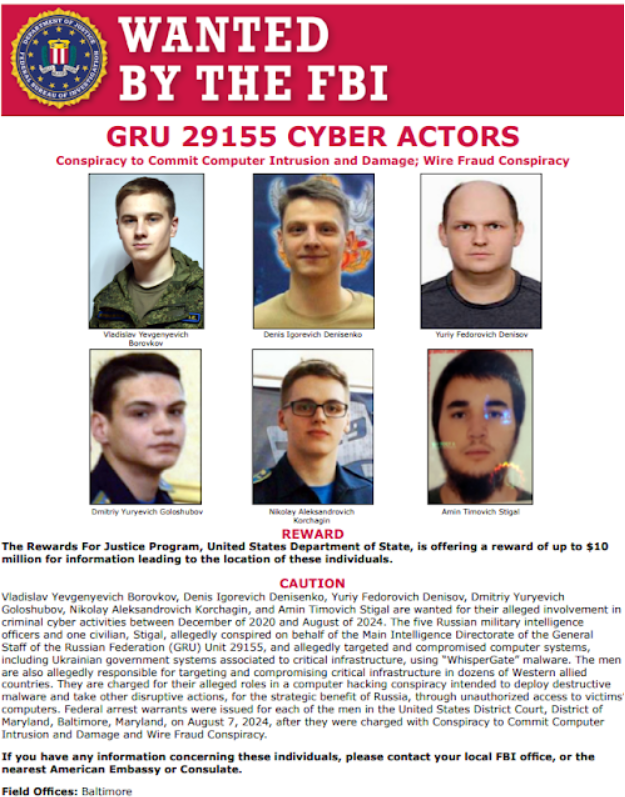
    Russian GRU military intelligence Unit 29155 (aka Cadet Blizzard, Ember Bear, FrozenVista, UNC2589) is a covert subunit of the Main Directorate of the General Staff of the Armed Forces of the Russian Federation (GRU), primarily tasked with conducting high-stakes and clandestine operations abroad. Established under the GRU, Unit 29155 gained public attention due to its involvement in activities that align with Russia’s asymmetric warfare objectives, particularly in Europe, Ukraine, and NATO-affiliated regions. Unit 29155 operates in several domains, from traditional espionage and sabotage to cyber operations.

    Unit 29155 has significantly intensified operations since 2020, pivoting from covert actions in Europe toward a greater emphasis on cyber operations with a focus on undermining Ukraine and NATO allies through espionage, data manipulation, and sabotage.

    Primary TTPs

    • Espionage and Data Theft
      • Unit 29155 conducts extensive espionage campaigns aimed at gathering intelligence from NATO countries, European union members, and multiple nations in Latin America and Central Asian. They’ve exploited critical infrastructure and government systems leveraging reconnaissance tools like Nmap and Shodan to scan for vulnerabilities and gather intelligence [2].
      • Sensitive information obtained through these operations are occasionally leaked or shared publicly in order to damage the reputations of their victims as part of influence efforts [3].
    • Destructive Operations
      • Unit 29155 was tracked as the group deploying the destructive WhisperGate malware, disguised as ransomware but meant to erase victim data. This wiper was used in targeting of Ukrainian governmental and critical infrastructure entities. This activity provided evidence of a clear shift to sabotage tactics aligned with Russian military objectives early in the Russia/Ukraine conflict.
      • Destructive attacks have also been directed towards logistics operations supporting Ukraine, as seen in repeated attacks against infrastructure crucial to NATO and EU support for Ukraine [2].
    • Infrastructure Scanning/Domain Enumeration
      • Unit 29155 engaged in over 14,000 documented cases of domain scanning, targeting NATO infrastructure and EU entities. The scanning has been described as preparatory, often identifying weak points for later exploitation efforts. Open-source and custom tools like Acunetix, WPScan, and VirusTotal were commonly used for this reconnaissance [3].
    • Cybercriminal Overlap
      • Not wholly unique to Unit 29155, but rather the broad spectrum of Russian state-sponsored APT groups, researchers report collaboration with known cybercriminal elements, employing non-GRU actors to facilitate operations. This working relationship extends the group’s reach and allows it to exploit technical expertise outside formal military ranks while obscuring attribution. It is also believed that this particular unit consists of primarily junior personnel and so may operate at a less sophisticated level than other groups like APT28 or APT29 [4].

    Mitigations and Recommendations

    Cyber defenders across critical sectors are encouraged to implement mitigations against known tactics:

    • Prioritize patching of known vulnerabilities and enforce multi-factor authentication (MFA).
    • Monitor networks for unusual scanning or reconnaissance activity and segment networks to mitigate lateral movement, post infiltration.
    • Use intrusion detection tools to monitor for technical indicators of compromise (IOCs) relating to Unit 29155.

    Unit 29155’s evolution highlights a blend of traditional espionage with enhanced cyber and sabotage capabilities, particularly in relation to high-stakes geopolitical targets. The expanded use of cyber tactics show the importance for affected nations and organizations to maintain vigilance and robust cyber defenses.

    References

    [1] https://www.fbi.gov/wanted/cyber/gru-29155-cyber-actors

    [2] https://www.nsa.gov/Press-Room/Press-Releases-Statements/Press-Release-View/Article/3895808/%5B3%5D https://www.cyber.gov.au/about-us/view-all-content/alerts-and-advisories/russian-military-cyber-actors-target-us-and-global-critical-infrastructure

    [4] https://www.rferl.org/a/germany-gru-russia-cyber-warning/33112764.html