Venezuela’s Role in LATAM as a Narco-State
Venezuela has increasingly become a narco-state where high-level officials enable drug trafficking to sustain their power. US authorities accuse Nicolas Maduro and his inner circle (dubbed “Cartel of the Suns“) of colluding with criminals to ship cocaine abroad. While not a traditional cartel hierarchy, this term best reflects how the regime allows criminal networks to operate in exchange for loyalty and funds. The result of this is a steady flow of cocaine through Venezuelan territory from Colombian producers, using Venezuela’s porous borders and ports as the transit points. These illicit revenues help Caracas offset economic collapse under sanctions, propping up Maduro’s government when legitimate oil income fell. In turn, Venezuela’s instability and lawlessness (fueled by drug money, corruption, and mass migration) have regional spillover effects, straining neighboring countries and providing openings for foreign powers to step in as patrons and exploiters.
Cuba’s Lifeline and Intelligence Footprint
Cuba has arguably the most intimate stake in Venezuela’s survival. Since the era of Hugo Chavez, a Caracas-Havana axis has existed where Venezuela ships subsidized oil to Cuba, literally keeping Cuban lights on. Without the Venezuelan oil lifeline, Cuba’s economy would be unsustainable, a fact that cements Havana’s interest in shoring up Maduro. In exchange, Cuba provides extensive political and security assistance. Over the past two decades, thousands of Cuban personnel, including doctors, teachers, but also security and intelligence advisors, have been posted in Venezuela. They advise and embed within Venezuelan military units and intelligence services, imparting Cuba’s decades of know-how in surveillance, counterintelligence, and political repression. This Cuban contingent is widely seen as a pillar of Maduro’s regime stability, helping prevent military coups and monitoring potential dissent. In essence, Havana leverages Venezuela’s turmoil (and its own advisors on the ground) to maintain an allied government and extend Cuba’s influence in South America. The partnership is deeply symbolic: Venezuela supplies Cuba with energy and funds, and Cuba’s security apparatus works to keep Caracas in friendly hands, frustrating US attempts to isolate the Maduro regime.
Russia’s Military and Strategic Leverage
Russia has has also cultivated Venezuela as a strategic foothold in the Western Hemisphere. Since Hugo Chavez reached out to Moscow in 2000, Russia became a vital source of arms, oil investments, and diplomatic backing for Venezuela. Billions in weapon sales, from aircraft to air defense systems, and joint projects in oil fields ensued, not always yielding profit for Moscow but serving a geopolitical purpose. In return, the Kremlin gained a significant presence in South America, fulfilling Putin’s ambition to challenge the US in its own backyard. By propping up Caracas, Russia forces Washington to divert attention and resources, effectively acting as a spoiler to US interests. Even amid Russia’s war in Ukraine, Moscow has maintained military ties with Venezuela. In May 2025, the two signed a Strategic Partnership Treaty to expand cooperation in energy, mining, defense technology, and intelligence sharing. Russian oil firms also quietly supply Venezuela with crucial diluents to keep its heavy crude flowing. Furthermore, Russia and Venezuela regularly engage in military exchanges and joint exercises, where Venezuela even hosted segments of Russia’s International Army Games in 2022). In past crises, the Kremlin showed willingness to deploy assets like sending strategic bombers and air defense units to Venezuela during moments of heightened US pressure. All of this highlights how Moscow leverages Venezuela’s anti-US stance and need for security guarantees to deepen its footprint. From intelligence operatives on Venezuelan soil to warship visits, Russia uses Venezuela as a forward base of influence in LATAM, complicating US strategic calculus. Notably, both countries vocally oppose US “unilateral sanctions” and invoke principles of non-intervention, aligning themselves at the UN and other forums. In short, Venezuela’s turmoil and isolation have been a golden opportunity for Russia to project its power westward, cementing an alliance that counters US presence in the region.
China’s Economic Stakes in Venezuela
China’s approach centers on economic and technological entrenchment in Venezuela. Over the last 15 years, Beijing has loaned Venezuela over $50 billion in exchange for oil. Even as Venezuela’s oil industry deteriorated, China remained its major buyer, responsible for nearly 3/4 of Venezuela’s oil exports, often through intermediaries to evade sanctions. Much of this oil repays Chinese loans, and steep discounts give China’s refiners a bargain supply. Outside buying oil, Chinese state giants hold enormous stakes in Venezuela’s oil reserves. As the chart below shows, Sinopec and CNPC together claim rights to over 4.4 billion barrels of Venezuelan oil.
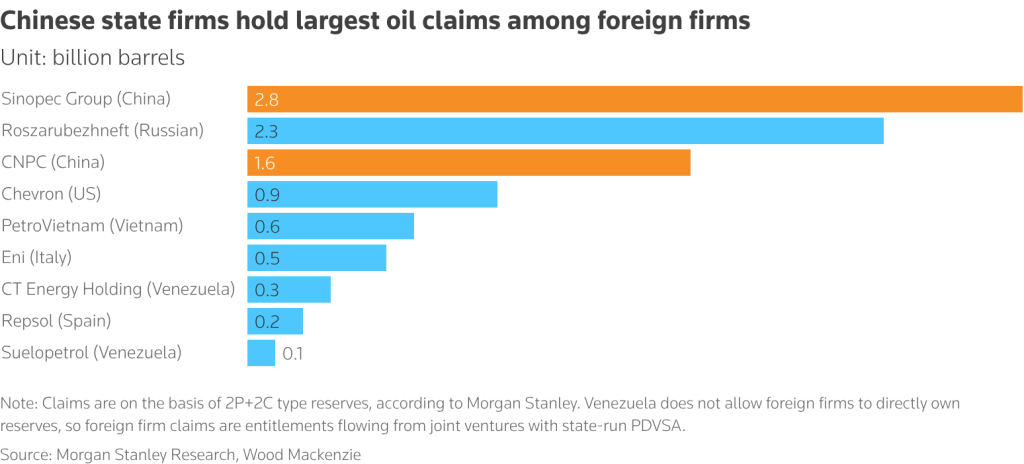
These investments grant Beijing long-term influence over venezuela’s most prized asset. China has also expanded into infrastructure and high-tech realms: Huawei built Venezuela’s national telecom backbone, ZTE designed the controversial “Fatherland Card” ID and social control system, and China’s CEIEC helped set up surveillance networks. Such technology transfers embed Chinese systems deep into Venezuela’s governance and security apparatus. In effect, Venezuela has become an outpost for China’s Digital Silk Road and resource acquisition strategy. Beijing leverages Venezuela’s financial desperation to secure favorable deals in oil, minerals, and telecom, all while portraying itself as Venezuela’s dependable partner amid US sanctions. China’s presence yields geopolitical dividends too; it gains political goodwill across LATAM for standing by Venezuela, and it challenges US influence by offering an alternative development model. However, China treads carefully; it has at times slowed new loans or investments, wary of Venezuela’s instability and inability to repay. Still, with a recent agreement on promoting bilateral investments (signed May 2024) and high-profile state visits, Beijing signaled its commitment to deepening ties with Caracas for mutual strategic benefit.
Venezuela as a Platform for Extra-Regional Influence
For Cuba, Russia, and China, an embattle Venezuela serves as a gateway to project power in LATAM. Under Chavez and Maduro, Caracas spearheaded an alliance of leftist governments (the ALBA bloc) that resisted US policies. Venezuela once bankrolled regional clients with oil subsidies (i.e. PetroCaribe program), buying influence in the Caribbean and Central America. Today, even with resources diminished, Venezuela provides a friendly territory for US rivals to operate. Intelligence reports indicate that Russian and Iranian military personnel have used Venezuelan bases to cooperate on drone programs and other strategic projects. Meanwhile, Cuba uses Venezuela as a forward post for its intelligence network in South America, extending Havana’s reach beyond the island. By hosting foreign military advisors, allowing port calls, or brokering diplomatic support, Venezuela amplifies the global influence of its patrons. Caracas often votes with Beijing and Moscow at the UN, and in turn receives diplomatic cover; for example, joint opposition to US “unilateral sanctions” has been a refrain of Venezuela, China, and Russia alike. The Venezuelan regime also harbors Colombian guerrilla groups and traffickers, whose activities destabilize neighboring Colombia and beyond. Importantly, Venezuela’s mere alignment with great-power competitors transforms it into a symbolic beachhead, demonstrating that US dominance in the Western Hemisphere can be contested. This emboldens other populist or authoritarian leaders in LATAM who seek multi-polar alternatives. In summary, Venezuela’s drug-fueled instability and anti-US stance make it a convenient platform for Cuba’s ideological agenda, Russia’s military forays, and China’s economic inroads, extending these countries’ influence throughout South America under the cover of “South-South” cooperation.
US-Mexico Counter-Narcotics Efforts
Facing an unprecedented fentanyl overdose epidemic at home, the US has refocused on counter-narcotics cooperation with Mexico as a linchpin of its regional strategy. over 100k American die annually from drug overdoses, primarily fentanyl, putting intense pressure on Washington to act. Most illicit fentanyl is manufactured by Mexican cartels using Chinese-sourced precursor chemicals, then smuggled across the US-Mexico border. Yet until recently, Mexico was reluctant to confront the cartels head-on, even claiming Mexico does not produce fentanyl. Cooperative security programs like the Merida Initiative stagnated as Mexico scaled back US law enforcement presence and hollowed out joint anti-drug efforts. This approach gave transnational cartels free rein, worrying US officials. In late-2023, however, signs of a shift had emerged. Through intense diplomacy (and some hardball tactics like hinting at trade tariffs), the Biden administration got Mexico to acknowledge the crisis. Bilateral agreements were reached in late-2023. Around the same time, China agreed to re-engage in narcotics cooperation, promising to police chemical exports more rigorously after high-level talks.
Concrete actions followed these understandings. US pressure coincided with Mexico’s military capturing major cartel figures, most notably Ovidio Guzman (son of “El Chapo”), who was extradited to the US in September 2023 on fentanyl trafficking charges. The US Drug Enforcement Administration also helped Mexican forces target clandestine fentanyl labs, while joint operations at the border (like Operation Plaza Spike) ramped up inspections of vehicles for hidden drugs. By late-2024, under mounting US pressure, Mexico reportedly deployed thousands of troops to its northern border and stepped up seizures of fentanyl pills and precursor chemicals. This growing collaboration is reshaping narcotrafficking routes as land routes into Texas and Arizona toughen, cartels have begun exploring alternate corridors via sea and Central America. There is also evidence that traffickers are adapting by using new chemicals and dodging Chinese export curbs, a reminder that the narco-network is flexible and will seek the path of least resistance. Still, Washington’s message is that Mexico’s partnership is critical. Improved US-Mexico cooperation also serves as a counterweigh to extra-hemispheric actors: it shows that North America can tackle its own security problems, leaving less excuse for outside powers to meddle under the pretext of addressing lawlessness.
Implications for US National Security and Regional Stability
These developments carry far-reaching implications. US national security is directly challenged when hostile powers gain a foothold in the Americas under the guise of aiding a beleaguered Venezuela. The growing presence of Russian military advisors, Chinese tech infrastructure, and Cuban intelligence operatives in Venezuela undermines the traditional US sphere of influence and could threaten American assets or allies in the region. For example, Russia’s support to Venezuela is explicitly aimed at countering US influence in LATAM. Such encroachment harkens back to Cold War era concerns and has led US strategists to reassert the Monroe Doctrine logic of keeping external adversaries out of the hemisphere. Indeed, Venezuela’s alignment with Cuba, China, and Russia is cited in Washington as an unacceptable beachhead for “the United States’ main opponents” in its backyard. The illicit drug trade exacerbates this strategic contest. The Venezuelan regime’s role in narcotrafficking not only finances its own repression; it also exports instability northward (in the form of drugs and refugees) and tarnishes US credibility when the problem grows. American policymakers argue that failing to check Venezuela’s narco-network and its foreign sponsors would embolden other anti-US regimes and signal decline of US leadership.
On the other hand, a robust US counter-narcotics push, especially in partnership with Mexico, could alter the balance. Success in curbing fentanyl flows and cartel power would deprive Venezuela (and by extension Cuba/Russia) of one modus operandi for influence (the chaos and corruption spread by drug money). It would also bolster US standing as a security provider in LATAM, perhaps reassuring countries that Washington, not Beijing or Moscow, can best address regional crises. Already, the extradition of a top fentanyl trafficker and the slight dip in US overdose deaths in 2024 have been lauded as proof that coordinated action yields results. However, there are risks. If the US approach veers into unilateral military action (as some hawks urge, citing narco-terrorism), it could spark backlash akin to past interventions, playing into the hands of Cuba, China, and Russia, who would eagerly condemn US “imperialism” and rally regional opinion against Washington. Striking a balance is key: the US looks to strengthen alliances (like with Mexico and Colombia) to choke off drug routes, while diplomatically isolating Venezuela’s regime and its enablers. The coming years will test whether this strategy can stabilize LATAM’s drug economy without inflaming geopolitical tensions. One thing is clear: Venezuela’s crisis has become a linchpin issue at the crossroads of organized crime and great power rivalry. The outcome will significantly shape US influence and the security architecture of the Western Hemisphere for years to come
References
https://www.theguardian.com/us-news/2025/nov/24/visual-guide-us-military-presence-caribbean
https://trendsresearch.org/insight/united-states-and-venezuela/?srsltid=AfmBOooU_sGam-laezyzxNB1kTSHF3U5-m8SBLF02JFkLDEmo5guIlv3
https://www.project-syndicate.org/commentary/cuban-agents-secure-nicolas-maduro-venezuelan-regime-by-jorge-g-castaneda-2024-10
https://www.atlanticcouncil.org/blogs/new-atlanticist/facing-the-threat-of-us-strikes-maduro-has-requested-russias-help-he-shouldnt-expect-much
https://www.atlanticcouncil.org/dispatches/delcy-rodriguezs-untenable-balancing-act
https://www.reuters.com/business/energy/putin-maduro-sign-strategic-partnership-agreement-2025-05-07
https://ridl.io/russia-has-no-allies
https://www.allbrightlaw.com/EN/10531/c2620fdc1b7fa923.aspx
https://www.brookings.edu/articles/china-mexico-and-americas-fight-against-the-fentanyl-epidemic
https://www.reuters.com/world/americas/mexican-kingpin-ovidio-guzman-extradited-us-source-says-2023-09-16
https://www.cfr.org/backgrounder/fentanyl-and-us-opioid-epidemic
https://www.cbp.gov/border-security/frontline-against-fentanyl
 The Security Brief