This analysis was prompted by recent reporting from Matthew Luxmoore at the Wall Street Journal, which highlighted how deeply military content has been integrated into Russian schools. I reviewed additional reporting, open-source research, Russian government documents, and independent analyses to understand the broader context.
Overview
Recent reporting by Matthew Luxmoore at the Wall Street Journal (WSJ) prompted a deeper look into how far the Kremlin has reshaped Russia’s education system for long-term militarization. His work highlights a trend that has accelerated significantly since the invasion of Ukraine in 2022, and after reviewing additional sources, the picture that emerges is sharper and more concerning than a single article can capture.
A Systematic Shift Since 2014
Russia’s patriotic education initiatives began expanding after the annexation of Crimea, but the scale shifted significantly following the 2022 invasion. Federal spending grew from roughly $40 million in 2021 to nearly $600 million by 2024, supporting curriculum rewrites, school-based training programs, and the proliferation of state-run youth organizations.
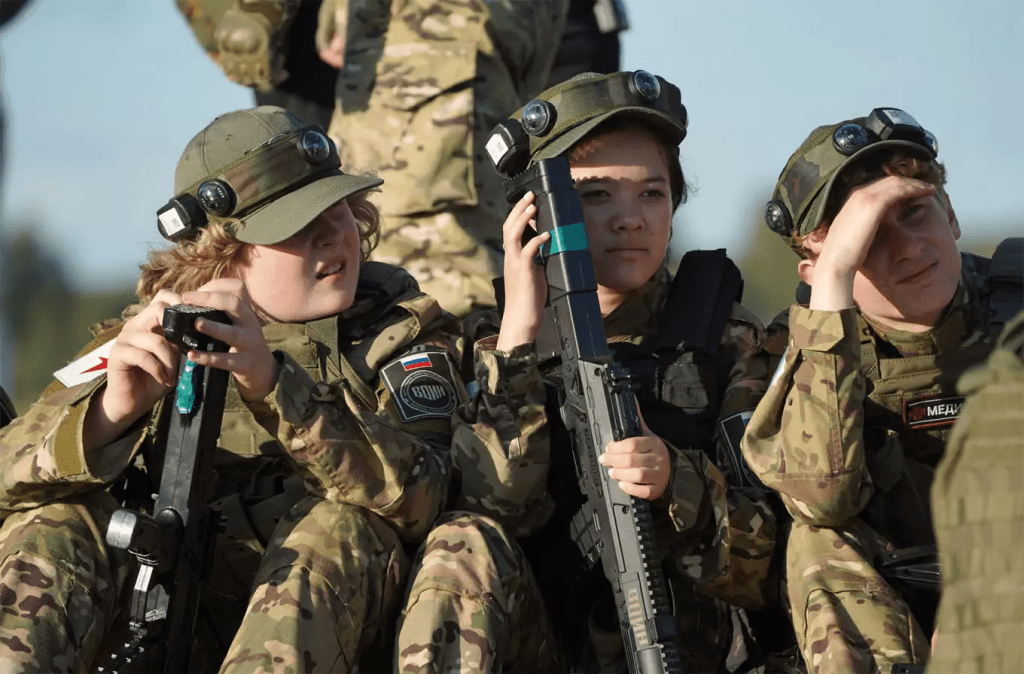
New standardized history and civics textbooks portray the US and NATO as direct threats and depict Ukraine as a Western proxy. Tactical training equipment and mock Kalashnikov rifles have been distributed to thousands of schools. In many regions, these activities are now compulsory, not extracurricular.
Education as a Mobilization Pipeline
The Defense Ministry’s Youth Army (Yunarmiya), established in 2016, now claims more than 1.8 million members. It operates as a nationwide cadet network that integrates students into military culture early and maintains engagement through adolescence.
Active-duty personnel increasingly teach in classrooms, leading instruction on weapons safety, basic first aid, drone operation fundamentals, and military discipline. By eighth grade, these courses resemble structured pre-conscription preparation. In occupied Ukrainian regions, Russia has imposed these same curricula while removing Ukrainian-language materials.

Strategic Messaging
The Kremlin frames these programs as tools for national unity and resilience. Critics inside Russia describe them as mechanisms for suppressing dissent and reducing independent thought. Teachers who resist implementation face administrative penalties or prosecution, underscoring the coercive nature of the effort.
While patriotism in Russian schools is not new, the current approach is more centralized, more compulsory, and more explicitly linked to real-world conflict. The expansion into early childhood (down to the first years of primary school) represents a significant change from previous decades.
Information Environment Pressures
A key driver appears to be the changing information landscape. Russian youth have greater exposure to Western media, global online discourse, and alternative political viewpoints than previous generations. Surveys consistently show that younger Russians are the least aligned with Kremlin narratives and the most likely to bypass state information controls.
This environment has prompted more aggressive ideological programming. Early-age indoctrination is used to establish state-approved narratives before outside information becomes accessible.
Implications for Future Confrontation
Taken together, these developments suggest deliberate social preparation for long-term geopolitical tension with the West. Russia is not only modernizing its armed forces; it is shaping future generations to accept sustained confrontation and large-scale mobilization as normal.
This generational strategy will influence Russia’s military posture, information operations, and cyber workforce for years to come. For the US and allied nations, it suggests a security environment where societal militarization becomes a persistent feature of Russia’s strategic behavior.
But let me know your thoughts!

 The Security Brief